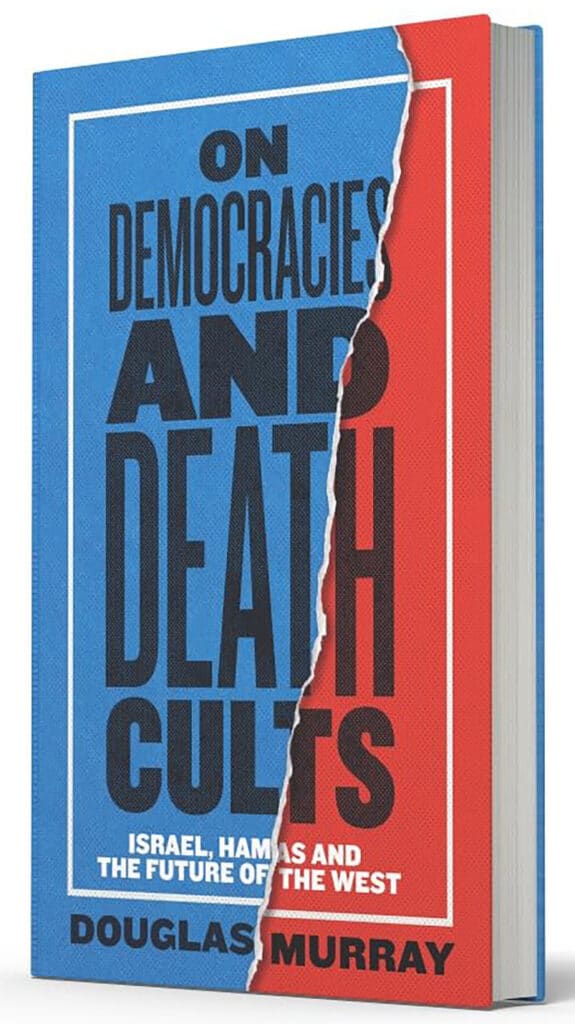


Few could forget writer and journalist Douglas Murray’s speech at the Lauderdale Road Synagogue days after the October 7th attacks. The world reeled from news that Hamas had breached Israeli defences and massacred more Jews in any single day since the Holocaust, taking back to Gaza hundreds more hostages. Although not a Jew, Murray's longstanding staunch defence of the Jewish people and their homeland made him well-placed to give those words of perspective, solidarity and comfort.
His latest book, ‘On Democracies and Death Cults: Israel, Hamas and the Future of the West', was therefore a natural topic for him to choose. This is no armchair pontification about Middle Eastern politics: the book reveals just how extensively Murray travelled throughout the region, entering areas of conflict and interviewing survivors, leading politicians and the military. That includes Prime Minister Benjamin Netanyahu, who answers Murray's questions about what went wrong on that fateful day. If you're looking for an account that uncovers the truth about the events of October 7th, then ‘On Democracies and Death Cults' is thoroughly researched.
Not only that but it is personal. The arguments set out in each chapter are compelling and persuasive because it's a subject that the author has long studied, and the writing comes from the heart. The last time I flew out of Ben Gurion Airport was only a few weeks before the massacre. As a foreigner and non-Jew, I can empathise with the strength of feeling that comes through in these pages. The book will have the same emotional impact on anyone who knows and loves Israel.
A revealing aspect of ‘On Democracies and Death Cults’ comes when Murray explains the Israeli national psyche and the coming together of its people when they are attacked. He sheds light on why the Israeli government agreed terms that appeared a poor exchange when negotiating the return of hostages. The ‘no Jew left behind’ ethos is the key to understanding why Hamas took so many hostages back to Gaza following the massacre. In one especially memorable passage, Murray speaks to IDF recruits, many of whom are young women in their late teenage years. Their task is to identify victims from body parts. The author underlines how such a psychologically toughening duty focuses the mind on what is important in a way that simply doesn't apply to young people in other western countries.
The most harrowing passages of the book are the personal stories from survivors whose family members, friends and relatives were butchered before their eyes. These pages recall traumatic events in often graphic detail. Nevertheless, they humanise the victims. Many were young and celebrating life at the Nova music festival, or lived in a kibbutz close to the border with Gaza. Murray provides a voice to some of those whose bloodied images were shared around the world.
‘On Democracies and Death Cults’ doesn’t simply provide a linear account of the events of October 7th and the aftermath of war. Murray also, characteristically, asks the difficult questions. Why the Jews? Why the hatred for their homeland? Part of his explanation takes readers back to the origins of the Iranian Revolution of 1979.
Murray touches upon the widespread anti—Israel, pro-Palestine demonstrations that quickly flared up on western university campuses and in major cities before the deceased had even been counted. My hope was that he would go further on this point. While he criticises the response of the then-incumbent US administration, politicians in his native UK emerge relatively unscathed, as do the celebrities and pundits who, for example, demanded an immediate ceasefire or hashtagged ‘All Eyes on Rafah'. Nobody can accuse Murray of pulling his punches when it comes to exposing the derangements afflicting the West, so perhaps his instinct was against reheating themes from earlier works. Although the chapter ‘How the world turned’ provides commentary on the reaction of the west to the conflict, the author wounds without killing his prey.
Although every chapter of ‘On Death Cults and Democracies’ is written in Murray’s crisp, engaging, journalistic style, it’s the final chapter that is arguably the most powerful. In these pages, Murray unpacks how his experiences in the war zone have shaped his thinking on what the future may hold for Israel and the Jewish people. Many of us recall his interview with Piers Morgan in which he calmly kept talking under rocket fire. Then the photograph emerged of Murray sitting in the ash-strewn chair in Gaza where Yahya Sinwar, the mastermind of the massacre, met his end, finally hunted down by IDF commanders and the politicians who decided on strategy. Reflecting on this personal experience, Murray offers a message of hope that the rest of the book has built towards. It could only have been written by someone with a deep and intimate knowledge of Israel and connection to its people. It is an appreciation of what is needed to make societies work. And why Israelis choose life.
Publisher: Harper Collins Publication date: 10th April 2025 Buy ‘On Democracies and Death Cults'
This article contains an affiliate link. Purchases through this link may result in us earning a commission.