

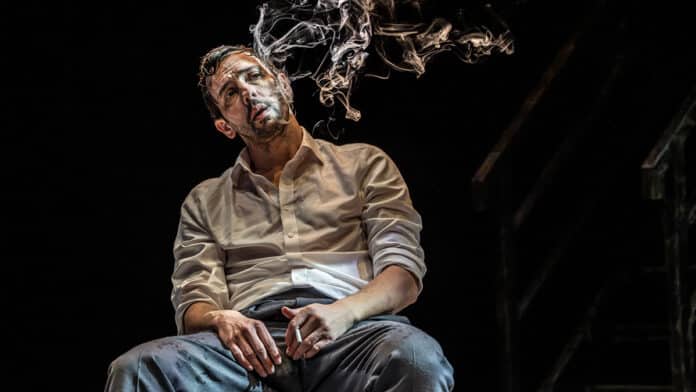

John le Carré's Cold War spy thriller, originally released as a novel in 1963, is brought vividly back to life in this faithful stage adaptation. The Iron Curtain of the Berlin Wall is currently erected behind the proscenium arch of the Churchill Theatre, Bromley. ‘The Spy Who Came In from the Cold' is set for a UK tour.
The star of the piece is Ralf Little, best-known to audiences for comedy roles in ‘The Royle Family' and ‘Two Pints of Lager and a Packet of Crisps' as well as for ‘Death in Paradise'. He stretches his acting mettle to take on the role of world weary spy, Alec Leamas, who doesn't have enough semblance of an ordinary life to object to one final job for Control…
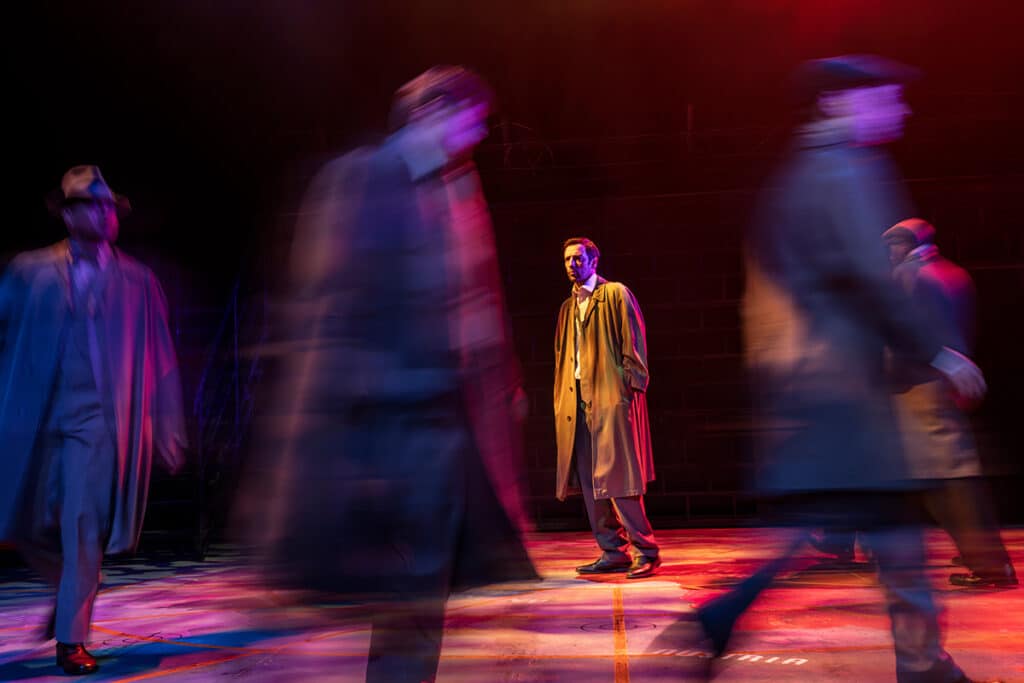
John le Carré's espionage world is certainly bleak. The tale avoids the glamour of a James Bond novel (Ian Fleming was just about still alive when the book was published). In many ways, ‘The Spy Who Came In From the Cold' is an anti-Bond story. The moral universe is one mass of grey, with no distinctive black or white, good or evil. Leamas is a British Intelligence operative who mourns the loss of his agent Riemeck (Jonny Burman), who had been the last member of his spy network operating out of East Germany. He was shot while trying to cross to the western side of the Berlin Wall by the vicious antisemite and former Nazi turned Communist Mundt (James Burman). When Control (Nicholas Murchie) and the enigmatic spymaster George Smiley (Tony Turner) persuade him to return to Germany and frame Mundt as a double agent in the hope his own people will kill him, Leamas has a personal motive to take the revenge mission.
As a cover for Leamas' activities, he must first pretend to be a washed-up spy. Taking an ordinary job in a bookshop, Leamas meets the beautiful Jewish Communist Liz Gold (Grainne Dromgoole), but time in prison nearly derails their relationship. With the trap set, Leamas must play his part in Mundt's downfall. But like all good le Carré stories, you can't trust anybody, and nobody seems to be telling the whole truth…
David Eldridge's adaptation of le Carré's novel is close to the source material and intelligent. The audience isn't spoon-fed. You have to pay attention (or risk becoming hopelessly lost within the labyrinthine twists and turns of the plot). Jeremy Herrin's direction and the stage design ably demonstrate the motif of the piece – that everything is a game, but that even games involving life and death have rules. The production also conveys the bleakness of life in East Germany when it was part of the Soviet Union.
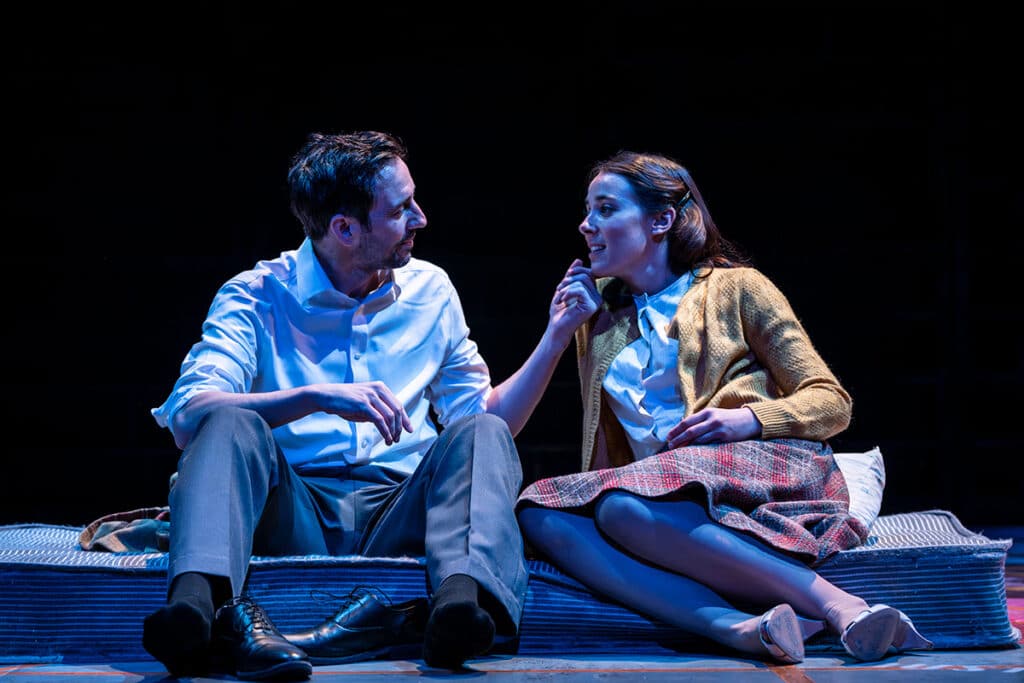
When analysing the leads, comparisons will inevitably be drawn to Richard Burton, who played Alec Leamas in the 1965 film adaptation of the novel, alongside Claire Bloom as Liz Gold. Ralf Little has the right kind of neutral face to convince as a spy, and he is especially good at embodying emotional detachment and world-weariness. We found his performance stronger when self-contained rather than in moments of hot-headedness. Regrettably, the romance between Alec and Liz, certainly never impassioned, doesn't quite convince. Little and Dromgoole save their best moments for the trial scene in the second act. There, Little allows himself the swagger of a desperate man, and his contempt for his captors is sincere and funny. Dromgoole's increasing desperation is also well-judged and affecting.
The cast is not watertight, and this is perhaps why a solid adaptation and thoughtful direction doesn't always keep alive a low-level sense of menace and suspense. We very much enjoyed Nicholas Murchie as the smooth, supercilious Control. James Burman convinces as the psychopathic Mundt.
Although there are dips in energy, ‘The Spy Who Came In from the Cold' benefits from some incredible moments. Leamas' attempted escape from his captors before his one-on-one encounter with Mundt is superbly realised. Little and Burman deserve enormous credit for this scene. It drew gasps from the audience, and quite a few spectators held their breath. The climax (being careful to avoid spoilers) is also strongly conceptualised and played. Overall, despite the production's imperfections, Jeremy Herrin ensures that ‘The Spy Who Came In from the Cold' is a solid and entertaining espionage thriller.
If you enjoy the le Carré novel or the film adaptation, and generally like Cold War spy stories, then ‘The Spy Who Came In from the Cold' has plenty to recommend it. We also commend the production for foregrounding the antisemitism that lies at the rotten heart of the ideals held by Mundt in the story, which have seen a recent recrudescence. In the current climate, this aspect of the storytelling seemed especially strong, timely and resonant.
Cast: Ralf Little, Jonny Burman, Melody Chikakane Brown, Grainne Dromgoole, Jeff D'Sangalang, James Burman, Nicholas Murchie, Jo Servi, Eddie Toll, Tony Turner, Clara Wessely Writers: David Eldridge adapting John le Carré Director: Jeremy Herrin Running time: 130 mins including interval Theatre: The Churchill, Bromley Dates: 24th – 28th March 2026 Book for ‘The Spy Who Came In from the Cold

