

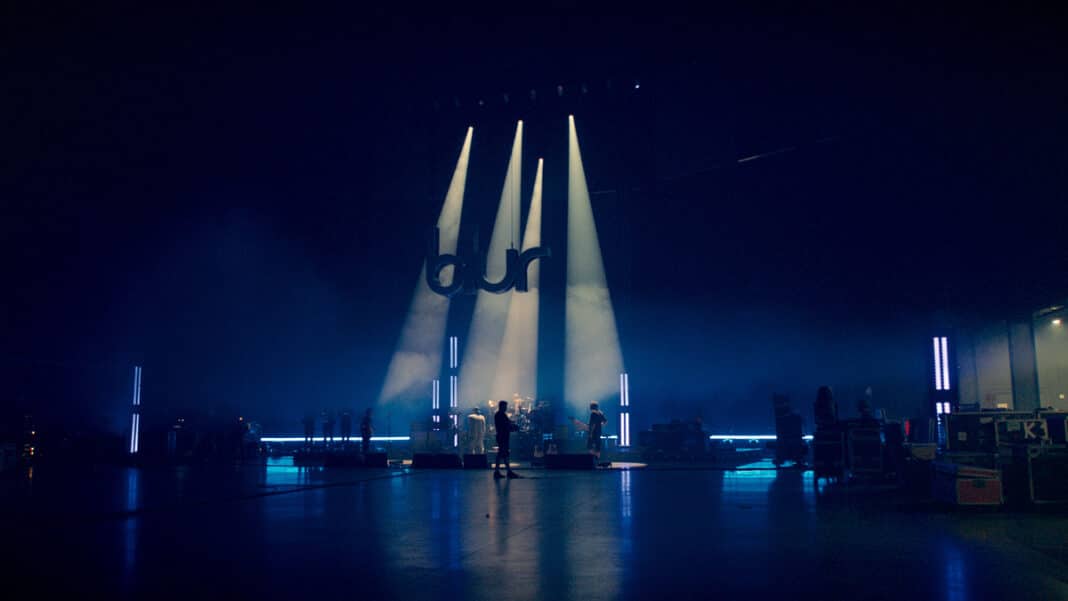

‘Blur: To the End’ is out in cinemas now. This intimate and utterly compelling documentary features Damon Albarn, Graham Coxon, Alex James and Dave Rowntree, and captures the band’s reunion whilst preparing to record a new album, their warm-up gigs and their personal journeys leading up to the biggest show of the band’s career – Wembley Stadium.
Director Toby L. is no stranger to the world of music documentaries having helmed the brilliant ‘Liam Gallagher: Knebworth 22’. We caught up with him again to discuss all things Blur, his challenges making the film, how Blur have shaped his life and what fans can expect to see from ‘To The End’.
Check out our 5 star review of Blur: To the End
It's good to talk to you again Toby. I haven't spoken to you since ‘Knebworth 22’. So a lot has happened in that time. Congratulations on the film. Absolutely loved it! I saw it last night and it really blew me away… and this is from a diehard Oasis fan as you know, so high praise indeed!
Toby L: Thank you! Haha yeah, I didn't really think I'll be speaking to you straight from a Liam Gallagher project to a Blur one! Such is life Jason!
Can you talk about how you first got involved with ‘Blur: To the End’?
Toby L: Yeah, so I think after doing ‘Knebworth 22’, I was really excited about the challenge of trying to create an intimacy with a huge environment – that was kind of really ringing in my mind after that incredible Knebworth experience. And more than I ever expected, I kind of wanted to do a stadium shoot again, and it was almost like that weird thought was put into the ether somewhere. I had been working with Damon (Albarn) and Graham (Coxon) from Blur on the other side of what I do, which is I run a record company. And so I've worked with Damon and Graham on separate musical releases over a few years.
So I knew those guys on that front. But I'd also done some filming with each of them separately over the years, as well. So I just thought, hang on a minute, what happens if we convert things, because my production company then asked to create a promo for what was going to be a surprise Blur reunion at Wembley Stadium, and I got very excited about it. And then off the back of that, obviously, I made this little promo, which is very much kind of a, sort of, a visual reference of the band in 60 seconds to then announce this gig. So I tried to cram as much in there as I could with as much vibrancy and memories and color and iconography from their career in 60 seconds with this end slate, they said Wembley Stadium.
So then I obviously said to the band and their management, hey, look, you know, I would love it if there's the opportunity to shoot the band at Wembley Stadium. And if there's a chance to tell a story, then great. And they kind of said, Yeah, thanks, Toby. And they sort of entertained it. But I didn't really hear anything for a while. I was then with Damon separately for a completely different project at his studio in West London. And I, basically, was chatting about something else. And then at the end of the meeting, he said, Oh, do you want to hear the demo for the new Blair album, then? And no one at that point knew that beyond the Wembley show, which was about to be or was being announced, that there was going to be a record. And I think even people at the studio were like, you know… there was this real sort of, kind of, amazed moment! And he then played me what were the demos of their record, ‘The Ballad of Darren’, which obviously came out last year, and obviously, even in their raw demo form, they sounded just beautiful.
It was clear that Damon had a very specific focal point and direction for that record at that point. And so it felt like really privileged information. But at that point in my brain, as you can imagine, I'm like, oh, wait a second, this isn't just the band getting back together for their biggest ever gig, there's also going to be this other new era of the band creatively. So at that point, I set out and I just wrote a treatment which I sent to the team in the band, which was, you know, effectively a kind of friendship story – an approach and direction to what could be a documentary, and then also a concert film.
And then again, as you know, people are busy, there's other things going on, I didn't really hear anything back, and I just sort of assumed that it went away. And then I was having breakfast with their amazing manager. And, you know, it was brought up an hour and a half into the breakfast. She said, ‘Oh, and by the way, the filming…’ And internally I was like, ‘Oh… I'm about to be turned down, politely, over breakfast with lovely eggs!’. And actually, the opposite happened. She goes, ‘No, yeah, we read your treatment. And, yeah, do you want to start making the film?’ and I was like, ‘Oh, fuck!’. And then honestly, from that point Jason, it was within a space of a few weeks, we were down in Devon, for the first part of, you know, the filmmaking process, which is when they were making the album and then that's the start of shooting. So yeah, and then we did six months of filming on-off with the band to tell the story. And then we finished post-production kind of at the beginning of the year, or rather the end of spring. And then here we are, and it's not one film, it's two films, and they're both coming out in the cinema, which I'm delighted about!
That's fantastic! Blur have obviously been the subject of lots of documentaries in the past, but your film really stands apart from all of them, because you're telling a completely different kind of a story and showcasing the different sides of the band, which I think was really fresh. As a viewer, I appreciated that. So I was wondering, as a filmmaker and a documentarian, how hard is it to keep delivering fresh perspectives on well-established subjects?
Toby L: Well, firstly, thank you for the kind words. I mean, it's not an easy thing, even with the Liam Gallagher project, you know, the network Oasis film (Oasis: Knebworh 1996) had just come out. It can be challenging. As you say, Blur are very well documented. My sort of feeling when it comes to the story is making sure that you acknowledge the existence of these beautiful artifacts that already are out there.
If I'm fortunate enough to add to the brilliant artifacts already out there on the band, and this is the latest installment of an artist/band’s story – it has to be a new story. There's no point retreading the same ground. So for me, it's then about my natural inclination to get a bit more emotionally deep. That's just my preference, I like to get philosophical and emotional. So if that's the opportunity for these artists that I'm lucky to spend time with, I just try and see how comfortable they are to go that far in themselves, you know? The last thing I want to do is uproot them in a faux therapy session. But I do think that great artists want to be challenged. And so I want to sort of challenge them in a supportive way to get their emotional story across.
Because as much as anyone can say, ‘in this year, we did this, and then we did that’, I feel like there's a much more interesting layer underneath all of that, which is, ‘yeah, but how were you getting on at the time? And what was going on in the wider world at that point that led to that happening’? You know, just trying to sort of create a bit more connectivity between the human spirit as well as the world at that time, in that moment. And that's kind of the angle. Truthfully, there's endless stories, you know, and then the challenge becomes, ‘what's the overall story you're telling?’ and sub-stories and the arcs of each character – you then have to rein yourself in.
When you shoot for six months, there's probably four films that we could have made, but this is the one that was the closest to the one that I wanted to make at the beginning, which was about friends getting back together to undertake their biggest challenge yet. And to, yeah, reflect on life as it stands, you know, and mortality – those are the things I wanted to focus on. And those were the themes that thankfully came together at the end, if that makes sense.
Yeah, absolutely. It's a very personal journey, and the human-interest element is what stands out the most, I think, in your film. Can you tell us about how you found the band before you started shooting? And how were they after you finished? Where there any differences or changes that you observed?
Toby L: That's a really good question. I mean, I would say like in terms of… they were pretty consistent as individuals throughout the process, you know, I think they're not really in it for fame or attention. So I think understandably, initially, at times having a camera in the room is a bit like, ‘oh’, but you know, my job is to kind of put everyone at ease and just go, ‘Yeah, I'm in the room and we just happen to have a camera. Don't worry about it’. I'm not there to sort of do a hatchet job. I'm literally there just to convey things as they happen, and try and provide an undistorted view of what happened. And in order to do that, you have to create a kind of convivial, empathetic energy. You can't just go in there and have lighting and catering and three assistants… like we try and make it as reductive as possible. So it's me, my DOP, and that's it. And then any production stuff, or in a car… like it's really old school documentary making.
That was the thing that I think the band agreed to at the beginning, they were like, ‘We don't want this to be flashy or interruptive. It's got to be real. It's got to be honest’. And, you know, one thing I've been talking about in relation to this film that's been conscious is that I think the process is really important. I think a lot of documentaries, the last five years in particular, have become increasingly stylized and phony frankly, and, you know, yeah, they might be entertaining, but I just feel like they're trying to manipulate the viewer to march into a version of reality. Whereas I feel like what we're trying to do is tell reality and real stories and hopefully something with emotional heft and a bit of inspiration. So even if you've gone on an emotional journey, and you've learned something, hopefully at the end do you feel inspired? I want to make old fashioned, inspirational cinema from documentary rather than it being ‘Oh, wow, look, we've got the glam person, we're gonna get the subject looking dead center in the screen in a really beautiful shot. And then we're going to add dramatic fucking score’. I hate all of that. We need to reverse the car out of that garage and go on a different motorway with documentary-making because it's so bloody cliched and it's artificial. So I'm doing my little bit to fight against that!
About the visual element of the film, and especially a few of the live shots, I thought they were really interesting, especially the Newcastle gig. I'm assuming you're in the pit when you shot that, and you were filming upwards towards Damon as he was performing to the crowd. That was an incredible series of shots. I was just wondering whether filming those lead-up shows provided a kind of new perspective for you, and how you wanted to shoot the live stuff? Or was there any kind of challenges that you didn't foresee?
Toby L: No, I mean, thank you for observing that, that means the world to me. Like I wanted to shoot them like they were a punk band at those gigs, you know, because you don't see many stadium bands shot at that proximity. And with that level of fanaticism and the reason so much of the film is handheld is that if you start putting things like cameras on sticks and a tripod, so you have steady cams, you're losing the fluidity of motion that like being in a mosh pit, or like being a performer on stage. So for me, I said to the DOP, ‘whatever fucking Damon does, whatever Graham does, whatever Alex and Dave are doing… whatever you can get, you're moving with the tempo and the cadence of the performance’. And it just so happened in Newcastle. That's where the essence of that feeling all came together like we were beyond close, like we were so close!
And Damon… as you can see, there's water on the lens in those shots because he's throwing pints of water into the crowd and at times, even threw a pint of water on me – he just threw one at me directly and one over our camera, like worth tens of thousands of pounds! And what’s beautiful is that the viewer is given that incredible essence of live energy, which again, this is the other thing that I struggle with is the way live concerts are filmed or festivals are covered. I feel like it's more coverage and safety shots rather than actually emotional connection. How in tune are you with like the cadence and the tempo of the song and the rhythm of the song and the melody of the song? And so whenever we shoot live stuff, I always want to make sure that the camera operators are empowered to be way more free and dangerous. And I'd much rather have a dirty, energetic exciting shot than a clean, perfectly framed shot that is absolutely sterilizing to the actual product. It's shooting. So I'm really pleased you picked up on that!
And then I guess ultimately from Newcastle, a tiny gig by their standards, up to Wembley Stadium, we wanted to maintain that spirit of punk rigor, energy chaos really. So for me it was trying to make Wembley Stadium show the expanse and the grandiosity by some of these beautiful shots we were lucky to have on all this amazing grip and engineering we put in, but equally in and around each member of the band. There's a handheld on every single member of the band at Wembley, and a lot of the concert film was just handheld… dirty, close-up shots of the band. It's like we've got 20 angles, and yet some of my favorites are just dead, the handheld angles, filming them as if we're in the mosh pit at Newcastle, you know?
There was a month’s gap between the end of the warm-up gigs to Wembley Stadium. Damon talks about this directly to you behind the camera during the film. I was wondering, how did that come break about? And what was going on during that time?
Toby L: Well, it was… I mean we left it in to kind of break the fourth wall, a bit of Damon going, ‘where the fuck have you been for the last month’? And he knows this. And it's okay to talk about that. But like it was always intended to have that break! We were going to have a month off filming. By that point, we've spent quite a lot of time going from the studio sessions, to rehearsals, to production rehearsals, to the warm ups to the first big festival show. By that point, it was a few months in the filmmaking. And it felt like ‘cool, let's give it a month, because life will happen in the interim’. And I didn't want everyone to get too comfy with each other. Right? You know, even though the vibes and camaraderie was good, I just knew from experience that things would happen.
It meant that when we next carried-on filming and picked up on filming, things would have moved forwards. And it's nice to sometimes have that recollection without having to see it, and obviously, lo and behold, a bit of like ‘Director's darkness’ had crept in because Dave had an injury. It's like comedic the way it's discussed in the film, but obviously, part of me was like, as much as I was worried on a human level that he was going to be okay, and the Wembley gig wasn't going to be canceled, there's also part of me, (the filmmaker of me), where it was like, ‘oh, there we go, something's happened!’. Yeah, so that immediately gave us a bit of a lift-off point to go from. What the hell's happened and beyond this, what else has happened? And it just means that the last act of the film has got a sense of containment and distinction. You know, I feel the film is quite tranquil and beautiful in Devon, but then it gets a bit faster and a bit more intense and a bit more heavy and a bit more emotionally-taxing. And then you have a breath, and then you've got the euphoric rise at the end. So, you know, that was that was kind of the aspiration for the break really, but yeah, I mean, it was funny when Damon was like, ‘Where the fuck have you been? Basically, it was ‘You were gonna have a month off!’
Your history with Blur as a fan, and obviously now as a documentarian – how has that journey been for you personally? And at the end of filming this, did you have a particular favorite moment from everything you captured?
Toby L: Yeah… well that's a big question. I mean, I think it's sort of been said publicly now, in relation to the film, that the first band I ever saw when I was 10 years old, was Blur at Wembley Arena. And then I had no idea that sort of years on from that point, I would be filming them at Wembley Stadium and making this film… it feels like the honor of a lifetime, it really does. You know, like, they were the band that got me into music, really, and into art, and into so much of my kind of thinking about society, and politics, and other artists and music. They really were the perfect gateway band in the late 90s. For a kid in the middle of nowhere, you know, they were an amazing inspiration. So, I guess it feels like a privilege to be able to kind of give some energy and oxygen back into that impact that they had on me, and hopefully, for the rest of their fans. And who knows, maybe this being a part of their chapter in their legacy as well. You know, it feels like such a wonderful way to give back that love that, you know, I felt from their music for all that time.
And then, in terms of the moments, I mean, it was innumerable from the first moment that we started shooting in Devon, as they made the record to be in the same room as Graham recording the guitar lines to ‘The Narcissist’ to Damon putting down the final changes on songs, and the rest of the band playing their own parts and all the way through to then seeing those prickly moments in the rehearsals that you're like, ‘oh my God!’, I can't believe obviously this happened. And thenI have to say like, I won't lie, during that walk-on shot where you see them walk onto the stage for the first time at Wembley Stadium. I was there with the monitor. We’re trailing Damon and the band in front of 80,000 people. I'll never forget that moment! Every hair was on-end. And it was electrifying. I had my own version of walking on stage at Wembley Stadium and it was magical. It was truly magical. And I'm just delighted that I don't get to keep these moments or memories for myself – it’s now embodied forever for everyone else to enjoy as well. So that's the greatest thing – that as much as I have these personal moments, my personal moments become everyone's moments. It's such a privilege to share them with everyone.
‘Blur: To the End’ is in cinemas now.

