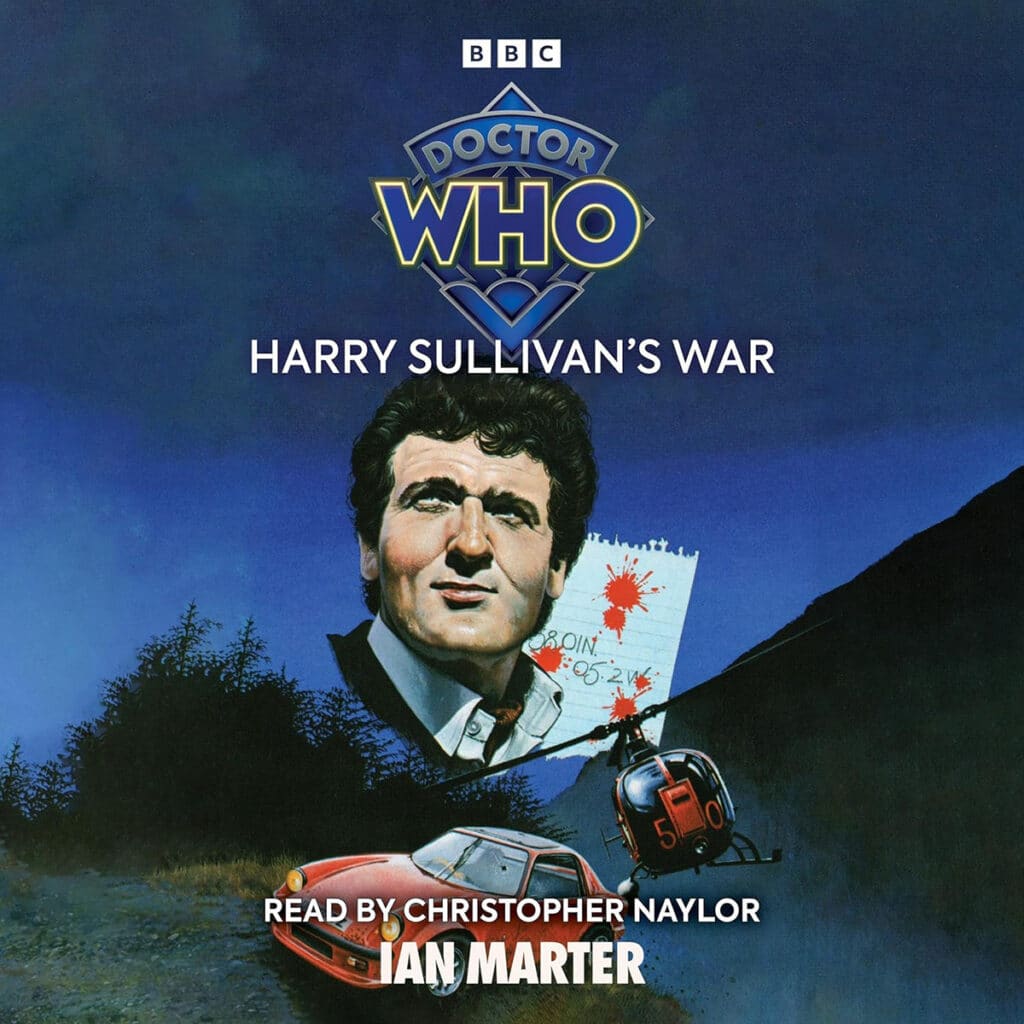



I still recall the sheer, unadulterated joy I felt on reading ‘Harry Sullivan’s War’ as a child, shortly after it was published in 1986. As a devoted fan of the Target range of ‘Doctor Who’ books (indeed, apart from Ian Fleming’s ‘James Bond’ stories I read little else up until the age of eleven) I felt an initial reservation before reading this title. It featured beloved Fourth Doctor companion Harry Sullivan, but no Doctor! However, this imaginative world of espionage, in which Harry goes undercover to solve a mystery was, to my eight year-old self, the perfect marriage of my two literary passions – ‘James Bond’ and ‘Doctor Who’.
I told all of my friends at school to read ‘Harry Sullivan’s War’ (though I doubt any of them did), drew a reproduction of David McAllister’s striking if inaccurate cover art, and presented to the class about “my favourite book”. So enamoured was I with ‘Harry Sullivan’s War’ that I didn’t dare read it again in adult life in case it didn’t live up to my cherished memories. But I broke that self-imposed rule on a long-haul flight a handful of years ago. Finding it funnier than I had as a child, I remembered what it was that I had loved about the book all those decades earlier and recaptured the joy.
Nostalgia is a powerful emotion that helps us to forgive flaws and overlook weaknesses. Does the ending really make much sense? Who cares when you have amiable old blunderer Harry Sullivan taking on the secret identity of Laurey L Varnish (a daft and unconvincing anagram of his name), taking plenty of nasty blows to the head, getting involved with a girl, uncovering a conspiracy and deciphering secret codes! Oh, and he drives a fast car too. Not only that, but ‘Doctor Who’ fans will be delighted when Harry manages to catch up with his old friend from UNIT, Brigadier Lethbridge-Stewart. Over dinner in a gloomy and mysterious old castle, they discuss the Doctor’s adventures (some that they weren’t in together – a playful touch by Ian Marter suggesting untelevised adventures).
Later in the story, just as Harry has gotten himself in a right old pickle and all seems lost, he is visited in prison by another old friend from his time with UNIT – Sarah Jane Smith! The much-loved investigative journalist, played by the late Elisabeth Sladen, is probably the most popular ‘Doctor Who’ companion of all time, to the extent of having not one but two of her own TV spin-offs. Marter, who teamed up so well with Sladen on screen, captures Sarah Jane’s pluckiness and indefatigability brilliantly well on the page. The scenes they share together in the book are a thrill for ‘Doctor Who’ fans to experience.
What I didn’t know as a child, just as I fell in love with the fantastical world of spies and adventure that Ian Marter (1944-1986) created, was that the author had sadly died, aged only 42, a month after the book was published. It was a loss to the world of ‘Doctor Who’ because Marter had proven himself to be a fine writer working on novelising the classic adventures for Target Books.
For that reason alone, it’s wonderful to see Ian Marter’s legacy celebrated with this audiobook version of ‘Harry Sullivan’s War’. It is narrated by Christopher Naylor, a natural and obvious choice as has played Harry Sullivan in Big Finish audio adventures and so is already linked to the character in the minds of fans. Naylor does a decent job here. He doesn’t try to do an impression of Ian Marter’s performance, but rather gives his own take. There’s a temptation to send up well-bred yet ineffectual Harry Sullivan that Naylor wisely avoids. His accents are hit and miss, with American proving especially elusive. There is an attempt to build up the prose with sound effects that is only partially successful. The musical sting to embellish the story’s espionage element is hackneyed and over-used, ultimately becoming irritating. There is an element of pastiche in Marter’s writing, but over-emphasising it works against the author’s intentions.
Nevertheless, it’s Ian Marter’s prose that retains the listener’s interest and carries them to the end of the book. And in the final analysis, ‘Harry Sullivan’s War’ is an enormously enjoyable children’s adventure story that rips off all of the best espionage writers. I can see why I fell in love with the book as a child. Marter truly does throw the kitchen sink at it, and it can’t be more than 60,000 words in length. It is also ahead of its time. Harry is redeployed from working on antidotes to nerve agents to developing weapons, which doesn’t sit well with him at all. There’s a strong environmentalism theme that runs throughout the story too that help it to stand up well today, even if Harry Sullivan himself is a creature from an entirely lost and forgotten epoch.
Part of me will always love ‘Harry Sullivan's War', and I find it hard to be objective about a book that meant so much to me as a child. It isn't exactly Fleming, less still le Carré, but as a spin-off from the world of ‘Doctor Who', it's way better and more fun than it has any right to be. Ian Marter probably was the most talented writer working on the Target range of novelisations. The frustrating thing is that ‘Harry Sullivan's War' could have been the start of a lucrative career for Marter, which was unfulfilled because of his early death. But we must be grateful that he lived to complete this wonderful story. For ‘Harry Sullivan's War', thank you Ian Marter. I treasure those childhood memories.
Publisher: Penguin Random House UK audio Publication date: 5th December 2024 Buy ‘Harry Sullivan's War'