

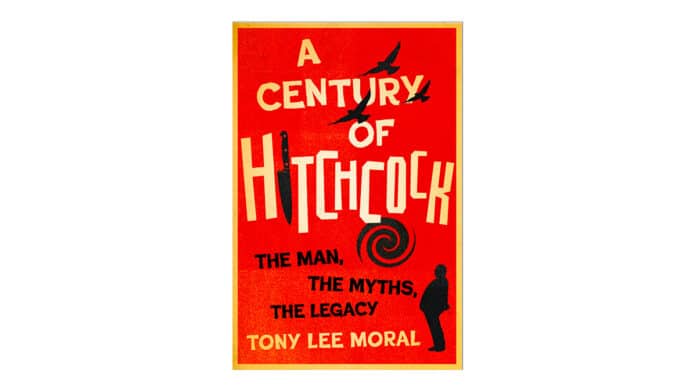

Alfred Hitchcock is one of the most iconic filmmakers of all-time, with an impressive list of credits unparalleled by any other director. Making his debut in 1926 with the silent film ‘The Pleasure Garden’, Hitchcock went on to be known as the ‘Master of Suspense’ thanks to his anthology series ‘Alfred Hitchcock Presents’ and his incredible films such as ‘Vertigo’, ‘Psycho’ and ‘Rear Window’. Hitchcock died aged 80 in 1980 but this year marks a centenary since the auteur released his first film. To celebrate the occasion Tony Lee Moral is releasing ‘A Century of Hitchcock’, a new book that looks back at the director’s legacy.
British filmmaker and author Moral has written four books dedicated to Hitchcock – ‘Alfred Hitchcock Storyboards’ (2024), ‘The Young Alfred Hitchcock’s Moviemaking Master Class’ (2022), ‘The Making of Hitchcock’s The Birds’ (2013) and ‘Hitchcock and the Making of Marnie’ (2013). With ‘A Century of Hitchcock’ Moral is revisiting Hitchcock’s much-celebrated career across the book’s first two parts – ‘The Rise of Hitchcock’ and ‘The Unraveling of a Genius’.
‘The Rise of Hitchcock’ starts in 1925 as the burgeoning filmmaker arrived in Germany to make his first film at the age of 25. It continues through the 30s as Hitchcock really began to garner attention for his filmmaking through films like ‘The Man Who Knew Too Much’ and Moral gives an insight into what being on a Hitchcock set was really like. Hitchcock’s relationship with producer and screenwriter David O. Selznick, who contracted him, is a fascinating section of Part 1. Moral explores the frictions that arose between the two men, both of who were obsessive about control over the pictures they were making. Despite those tensions though, Hitchcock made ‘Rebecca’, which earned an incredible 11 Academy Award nominations and took the director’s success to a whole new level. The final chapter of Part 1 details how Hitchcock used his early success to cement his position as the finest director in the film industry, during the time he made some of his best-known films.
Moral moves on with Part 2, ‘The Unraveling of a Genius’, to shine a spotlight on how Hitchcock’s fame started to overshadow his work. Having struck gold with his leading ladies, and leading men, Moral discusses how Hitchcock turned his attention to model Tippi Hedren who he famously had a tumultuous relationship with. It’s here that Moral offers a different perspective on the relationship, suggesting that it may not have been quite as the actress has recalled it over the years. Moral really digs into the making of ‘The Birds’ and ‘Marnie’, offering insights that I’ve never heard before. It wasn’t just Hedren that Hitchcock battled with during ‘Marnie’, it was Diane Baker too who accused the director of inappropriate behaviour. This is one of the most interesting parts of the book and will be a real draw for fans. It just goes to show that experiences are unique to each person and that the truth of what really happens is always somewhere down the middle.
Beyond that, Part 2 looks at how Hitchcock began to struggle as his films weren’t receiving the acclaim and accolades he’d become used to. This is to be expected from anyone as prolific as Hitchcock was, and his struggle to find material to inspire new films become more and more difficult. The director also struggled to recruit the level of star he’d become accustomed to, which led to one of his least successful on-screen pairings of Paul Newman and Julie Andrews for ‘Torn Curtain’. Part 2 wraps with Hitchcock’s decline, both as a filmmaker and his health, before he eventually passed away in 1980.
Ther third and final part of the book – ‘Hitchcock’s Legacy’ – is perhaps the most compelling part of Moral’s book. While there are plenty of insights that you won’t have heard before in the first two parts, the final part looks back at the icon’s legacy and attempts to counter some of the accusations and criticisms that have been levelled at him. Moral details some of the revelations that came from Hitchcock’s lead actresses following his death, and he claims that American biographer Donald Spoto deliberately misquoted his interviewees to build his own narrative for his book ‘The Dark Side of Genius’. Moral goes on to suggest that financial motives were behind Spoto and Hedren’s continual willingness to talk about Hitchcock. He really digs in his heels about Hedren in particular, pulling a quote from Chicago film critic Pat McDonald who said that Hedren has been obsessed with Hitchcock essentially because she had failed to reignite her career after him.
Moving on from that, Moral takes a look at how Hitchcock’s name was brought up again during the #MeToo movement where the filmmakers work was looked back at through a contemporary lens. The final chapter of the book moves on to more positive material as Moral looks at the influence and effect that Hitchcock has had on the generations of filmmakers that have come after him. It’s not hard to see that many of the modern filmmakers have been hugely inspired by Hitchcock’s mastery, and it’s true to say that few of them have come anywhere close.
‘A Century of Hitchcock’ is a fascinating read and one that offers something different from the usual narrative around the filmmaker. It’s fair to say that Hitchcock was a difficult and complex man, often obsessive over his films and how they were made, but it’s important to remember that you can’t judge someone through societal standards that weren’t in place at the time. Moral offers up plenty of food for thought and for many, this will be an opportunity to see Hitchcock in a completely different light.
Publisher: University Press of Kentucky Release date: 9th June 2026 Buy ‘A Century of Hitchcock’ now
This article contains an affiliate link. Purchases through that link may result in us earning a commission.

