

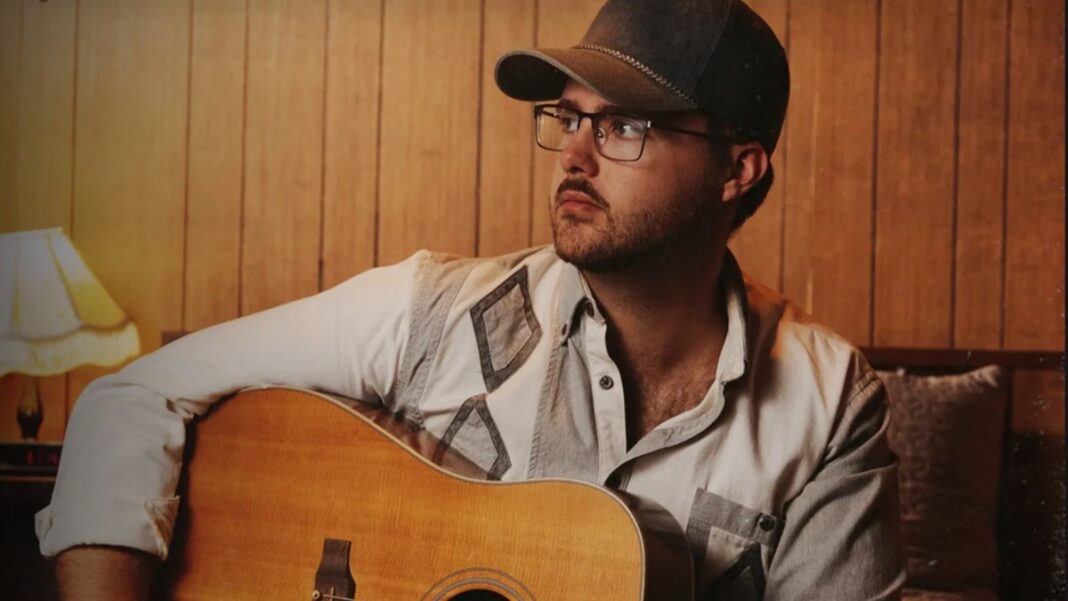

Rising traditionalist Kenny Whitmire is quickly carving out a lane of his own in modern country, blending classic influences with a fresh, contemporary edge. Recently signing with MCA Nashville, Whitmire arrives at a defining moment in his career with the release of his debut EP ‘Fool In A King Size Bed,' out today (June 12). A songwriter at heart, he has steadily built momentum through a string of releases including ‘Me Being Me,' ‘I Gave Her The Moon,' ‘You’re Getting Colder' and ‘Thought Twice About Loving You,' each one showcasing his knack for traditional storytelling and emotionally direct songwriting.
Drawing comparisons to artists like Zach Top and Jake Worthington, Whitmire’s music leans into the timeless sounds of country while still feeling rooted in the present. His debut EP reflects that balance, offering a deeply personal snapshot of his life and influences, from honky-tonk energy to heartbreak balladry. As his audience continues to grow, Whitmire is taking his music on the road alongside names like Tracy Lawrence, Ian Munsick and Billy Currington, marking him out as one of the most promising new voices carrying traditional country into a new generation. We caught up with him in Nashville during CMA Fest week to talk all about it.
You made a pretty bold decision early on: leaving college after just one semester to pursue music. What gave you the confidence to take that leap?
Honestly, I just hated everything else I was doing. I was only taking a few classes, but I couldn’t stand it! (laughing) I knew pretty quickly it wasn’t for me. But I think what made it easier was that my dad had been in music growing up. He was signed to a smaller label in Atlanta and played in a Christian rock band, so he understood that pull.
So I went to my parents and said, “What do y’all think about me taking a semester off and just focusing on music? Playing shows, writing songs, seeing if this works?” And they were supportive straight away. By the end of that semester, I was like, “Alright… how about one more?” During that time, I started coming up to Nashville, meeting people, getting a feel for the town. And by the end of that second stretch, I just made the move. There wasn’t really a grand plan, it was more just following something that felt right and seeing where it led.
When you arrived in Nashville, did you feel that sense of imposter syndrome, being surrounded by so much talent?
Yeah, I mean, I still deal with that, pretty heavily, to be honest. (laughing) I don’t think it’s something that just goes away once things start happening for you. If anything, in a town like Nashville, it almost gets louder, because you’re surrounded by so many insanely talented people every single day. There are guys and girls here who have been grinding for ten years, writing incredible songs, playing every bar and writers’ round they can, and you listen to what they’re doing and think, “Man, that’s as good as anything I’ve ever heard.”
So when things start happening for you, whether it’s getting attention, signing a deal, having songs connect, it can feel a little surreal, and sometimes you catch yourself thinking, “Why me and not them?” I’ve got buddies who I genuinely believe are some of the best writers in this town, and they’re still waiting on their moment. That can mess with your head a little bit, because you don’t ever want to feel like you’ve skipped a line or gotten something you didn’t earn.
At the same time, I try to remind myself that everybody’s path looks different. Just because things might be happening for me right now doesn’t mean I didn’t put in work to get here, and it doesn’t mean those other guys won’t have their moment too. Nashville has a way of humbling you constantly: you realise very quickly that talent alone isn’t what separates people. Timing, opportunity, relationships… all of that plays a part.
So yeah, the imposter syndrome is definitely still there, but I think I’ve learned to live with it a little more. Instead of letting it eat at me, I try to use it as motivation: to keep working, keep writing better songs, and keep proving to myself that I do belong here.
You’ve just signed a record deal with MCA Nashville, which must be very exciting? What does that change for you?
Man, it’s hard to even put into words what that means to me. Signing with MCA Nashville is one of those things you dream about when you’re a kid, especially if you grow up loving country music the way I did. You think about those labels, the artists that have come through them, the history behind it and then all of a sudden you’re sitting there going, “Wait, I’m actually a part of this now.” It’s pretty surreal.
From a practical standpoint, it’s a complete game changer. Before this, I was doing everything independently, which means you’re saving up money just to record one song at a time. You might put a single out, then wait a while before you can afford to do the next one. So your whole release schedule is dictated by what you can financially manage, not necessarily by your creativity or how much music you want to share. Now, having a label behind me, I can actually put music out as often as I want to, as much as I want to. That freedom is huge.
But beyond just the financial side, it’s the team aspect that’s made the biggest difference. I’ve got people now who are fully invested in what I’m doing: people who believe in the songs, who are working behind the scenes to promote them, get them heard, build something bigger than what I could do on my own. It allows me to focus on what I love, which is writing songs and making records, instead of worrying about every little detail that goes into releasing them.
So yeah, it’s exciting, but it’s also motivating. It kind of raises the bar for me, because now I’ve got a whole team putting their time and energy into this, and I want to make sure I’m giving them something worth believing in. It feels like the start of a new chapter where I can really lean into who I am as an artist and get that out to people in a much bigger way.
Your sound leans heavily into traditional country. Where did those influences come from?
I was always drawn to a voice first and foremost. Guys like Merle Haggard, Keith Whitley, Randy Travis, those were huge for me. And then someone like Vince Gill, not just for his singing but his guitar playing too.
I grew up on a bit of everything. My dad was a classic rock guy, my mum had whatever was on the radio, but I really discovered the deeper traditional country stuff on my own when I was in high school, when I started taking music seriously. I’d lock myself in my room for hours learning songs, and that’s where I really connected with that older sound.
Your EP opens with ‘Me Being Me.’ Was that a deliberate choice to introduce yourself straight away?
Yeah, that was definitely a really intentional choice. ‘Me Being Me' felt like the right way to open the EP because it’s about as honest and autobiographical as I can get. When people hear that song, they’re not getting a character or a made-up story, they’re getting a pretty direct look at who I am, how I grew up, what I value, and the kind of artist I want to be. So it just made sense to put that right at the front and say, “Alright, this is me—take it or leave it.”
At the time we were putting everything together, ‘I Gave Her The Moon' was starting to gain some traction, and there was a lot of excitement around that. But even with that momentum, I still felt like ‘Me Being Me' was the best introduction, because it lays the foundation for everything else on the project. It kind of sets the tone not just sonically, but personally. It tells you where I come from before you get into the heartbreak songs, the love songs, all the rest of it.
It’s also the first song I play in my live set for that exact reason. I like stepping on stage and opening with something that immediately lets people know what I’m about. There’s no easing into it: you hear that song and you pretty much understand my story straight away. From there, everything else kind of builds off that.
You’ve had a big viral moment with ‘I Gave Her The Moon.’ What was that like when it started taking off?
I was honestly just blown away when that song started taking off. It’s one of those things you always hope might happen one day, but you never really expect it to actually hit like that when it does. When I first started putting music out, you’re just trying to get people to listen at all, so to suddenly have something really connect on that level……it was kind of hard to wrap my head around at first.
I think especially now, with how important social media is, there’s a bit of a shift in how artists come up. There was a time not that long ago where being known as a “TikTok artist” maybe had a bit of a stigma to it, but that’s completely changed. Now it’s just part of the game. You almost have to build your audience there if you want a shot at this. So for me, having ‘I Gave Her The Moon' start to gain traction online, it felt like, “Okay… this is actually working. This is how people are finding music now.” And that was a really exciting moment.
At the same time, it’s not like I put the song out thinking, “This is gonna blow up.” I just believed in it and hoped people would feel something from it. So when it did start connecting, it was just pure excitement and a bit of disbelief. You’re watching the numbers climb, seeing people use the sound, seeing comments come in, and it takes a minute for it to really sink in that it’s real people out there responding to what you made.
And then, of course, once you’ve had that moment, there’s a whole other side to it. You start thinking about how to follow it up, how to keep that momentum going. I’d be lying if I said that doesn’t get in your head a little bit. You do find yourself staying up late, thinking about the next post, the next song, wondering how to recreate that. But I try to remind myself that the reason that one worked is because I wasn’t overthinking it, I was just making something I believed in.
So now it’s about staying grounded in that. The numbers are gonna come and go, things are gonna happen in waves, but all I can really control is continuing to make music I’m proud of and putting it out there consistently. That’s what got me there in the first place, and that’s what’s gonna keep things moving forward.
Artists like Zach Top and Bailey Zimmerman have come through that same viral pathway. Did seeing that give you belief it could happen for you? And then, of course, Charlie Puth got involved!
Definitely. Even when I first downloaded TikTok, I was seeing guys like Bailey Zimmerman and Warren Zeiders popping off, and it made me realise, “Okay, this is actually possible.” It’s opened so many doors.
Yeah, that was honestly one of those moments where you kind of have to double-check that it’s real. I mean, Charlie Puth was huge when I was growing up, like, when I was in high school, songs like ‘See You Again' were everywhere. I was in chorus back then too, so that kind of music was right in the middle of what we were all listening to and singing. So to go from that, to seeing someone like him engage with something I’d put out… it’s pretty surreal.
What makes it even crazier is just how respected he is as a musician. He’s not just a pop artist, he’s a guy people look at as a true musical mind. The way he hears things, the way he talks about production, melody, all of it… he’s kind of a genius when it comes to music. So for someone like that to even acknowledge what you’re doing, let alone show any kind of support, that means a lot more than just numbers or views. It feels like validation on a different level.
I think it also speaks to how music is crossing over more now. You’ve got people outside of country paying attention to what’s happening in the genre, and vice versa. So seeing someone like Charlie connect with a country song, it kind of reinforces that good music is just good music, no matter where it comes from.
Let’s talk about the EP title, ‘Fool In A King Size Bed.' It’s a striking image. Why that one?
The title just really stuck with me from the moment we wrote it. I remember going into that write with Rhett Akins, who, for me, is one of my heroes, and he came in with that idea. As soon as he said it, I was like, “Man, that’s such a vivid picture.” You don’t even have to hear the song yet, you can already feel what it’s about. It paints that image of someone who’s got everything they thought they wanted, but still feels completely alone in it.
For me, I’ve always been drawn to that kind of songwriting, the kind that makes you feel something straight away, especially sad songs. I’ve always said sad songs make me happy, and I think that’s because they’re honest. There’s no hiding in them. And that title, and the song itself, really leans into that honesty. It’s about heartbreak, loneliness and those quiet moments where you’re forced to sit with your thoughts. That’s a big part of what country music has always done well, and it’s something I naturally gravitate towards as a writer.
As we started putting the EP together, it just felt like that title summed up the whole project. Even beyond that one song, there’s a thread that runs through the EP: love, loss, reflection, figuring yourself out and ‘Fool In A King Size Bed' kind of captures all of that in one line. It also felt like the right way to introduce myself, because it shows people straight away the kind of artist I am. I’m not trying to be flashy or chase trends, I just want to tell real stories that people can connect with.
Heartbreak is such a core part of country music. Why do you think that resonates so strongly?
I think heartbreak and country music have always gone hand in hand because it’s just one of the most universal feelings there is. Everybody’s been through it in some shape or form: whether it’s a relationship ending, loving someone who doesn’t love you back, or even just losing something you thought was going to last. There’s something about that kind of emotion that people instantly recognise and when they hear it in a song, it makes them feel understood.
For me as a writer, I think that’s what draws me to it the most. You can take a really specific story, something that happened to you personally, and somehow it still connects with people in completely different situations. Someone might hear a breakup song and relate it to a friendship that ended, or something going on in their own life that has nothing to do with romance. It’s those shared emotions that make the song bigger than just the story you’re telling.
And I’ve always been a sucker for sad songs anyway. There’s something about them that feels more honest, more real. You’re not trying to dress anything up, you’re just putting it out there exactly as it is. I think listeners can feel that. There’s a vulnerability to it that you don’t always get in other types of songs, and that vulnerability is what makes people come back to country music over and over again.
Which song on the EP feels the most personal to you?
I’d probably have to say ‘Thought Twice About Loving You' is the most personal one for me on the EP. A lot of the songs come from real places, but that one hits especially close to home because it’s tied directly to my relationship with my wife. I got married a little over a year ago, we just had our first anniversary, and from the very beginning, from the first day I met her, I just had that feeling that she was the one. It wasn’t something I had to overthink or question, it just felt right straight away.
That song really captures that sense of certainty, but also the vulnerability that comes with it. When you love someone that deeply, there’s always that awareness of what you stand to lose, and I think that’s what gives the song its emotional weight. It’s not just a love song, it’s about commitment, about knowing you’re all in on something, and understanding how much that means.
I think what makes it stand out for me is that it’s not a hypothetical or a story I’ve imagined, it’s something I’ve actually lived. Every time I sing it, I’m thinking about her, about our relationship, about the life we’re building together. That makes it feel different from some of the other songs, even though I love all of them.
You’ve worked with some strong writers in town. Are you building your own trusted, creative circle yet?
I’ve definitely started to build a core group of writers that I really trust and love working with. Guys like Sam Banks, for example, he’s someone I’ve written a lot with, and we just naturally get each other. A guy like Dan Alley too, who I think is one of the most talented people in this town right now. I mean, I’m probably his biggest fan, he’s like a brother to me at this point. When you find people like that, it makes such a difference, because you’re not starting from scratch every time you sit down. There’s already a level of comfort and honesty in the room, and that usually leads to better songs.
I think that’s what you see with a lot of artists in this town, eventually they find their “class” of writers, the people they keep coming back to, and that becomes a big part of their sound. I’m starting to get there, but I’m still in that stage where I’m figuring out exactly who those people are going to be long-term. And honestly, I enjoy that part of it too, because it keeps things fresh and pushes you creatively.
The other side of it is just the volume of songs. I’ve got a lot of stuff written that’s just sitting on my phone right now: ideas, demos, full songs, so it’s about continuing to write, continuing to refine, and making sure that when it comes time to record something, you’re choosing from the best of what you’ve got. Having that circle helps with that, because you’re constantly sharpening each other.
So yeah, it’s a mix: building those close relationships while still staying open to new collaborations. I think that balance is what’s helping me grow the most right now as a writer and as an artist.
I wanted to go back a little bit in your catalogue, because after listening to the new EP and really enjoying that more traditional, neo-classic country sound you’re leaning into now, I went back and revisited some of your earlier material, specifically ‘Holler' from 2022. That track feels quite different sonically; it’s much more muscular, more modern, almost in that Jason Aldean, arena-country lane.
So I’m really interested in that transition. What was going through your mind at that point in your career when you were making songs like ‘Holler,' and how do you look back on that version of yourself now?
Yeah, I mean, looking back on a song like ‘Holler,' I still have a lot of love for it, but it definitely represents a different phase of me as an artist. When I first moved to Nashville, I was 19, and I think like a lot of people when they get here, I was trying to figure out where I fit. You come into a town where there’s a sound that’s working, there are artists having huge success, and you kind of assume, “Well, that’s what I’m supposed to sound like if I want to make it.”
So with ‘Holler,' I was leaning into that more modern, high-energy, arena-style country, kind of in that Jason Aldean lane, mixed with some of the stuff Luke Combs was doing at the time. And I loved that music, I really did. I grew up listening to it, and it was exciting to try and create something in that space. But at the same time, I don’t think it was fully me: it was more me trying to fit into what I thought the industry wanted.
I think that’s a pretty natural phase, especially when you’re young and new in town. You’re soaking everything up, you’re comparing yourself to other artists, and you’re trying to find that path. But after a year or two of doing that, I started to realise that the only way this really works long-term is if you lean into who you actually are. You can maybe get some attention chasing a sound, but you’re not going to build something real or lasting that way.
So the shift into the more traditional sound wasn’t some big, dramatic decision, it was more like coming back to what I’d always loved in the first place. Artists like Merle Haggard, Keith Whitley, Randy Travis, that’s the music that made me want to do this. Once I gave myself permission to lean into that fully, everything started to feel more natural, both in the writing and in how I was presenting myself.
And it’s funny, because even now, ‘Holler' is still one of the most requested songs when I go back home. People love it, and I’m grateful for that, but I don’t really play it much anymore. I kind of let them ask for it and keep it as part of that earlier chapter. For me, it’s a reminder of where I started and how I got here, but also of how important it is to stay true to yourself as an artist.
You’ve been out on the road with artists like Ian Munsick. What have you learned from those experiences?
Being out on the road has probably been one of the biggest learning experiences for me so far, especially getting to spend time around artists like Ian Munsick. We just came off the road with him, and honestly, he was incredible: not just as a performer, but as a person. Him and his whole crew, the way they run their operation, the way they treat people, it really stood out to me.
What stuck with me the most is how genuine he is. He’s one of the nicest guys you’ll meet, and that carries over into everything: how he interacts with fans, how he treats the people on his team, how he handles being in that position as the headliner. After the tour wrapped, he even sent me a message just encouraging me and speaking life into what I’m doing, and that meant a lot. You don’t forget stuff like that.
Honestly, the biggest takeaway is that the people who last, the ones who have real careers, are usually the ones who treat people right. It’s not just about the music, it’s about the way you carry yourself day to day. Seeing that up close has been huge for me, because it gives you a blueprint for the kind of artist and person you want to be.
So yeah, I try to soak all of that in. Every tour, every show, every interaction: it’s all part of the education. I’m still very much learning, but being around people like Ian and others in this business has definitely given me a clearer picture of how I want to do things moving forward.
Looking ahead, what do you want the next year to look like for you?
I mean, if we’re sitting here having this conversation again this time next year, I’d love to have my first full-length record out: that’s probably the biggest goal on my mind right now. The EP feels like an introduction, like the first chapter, but I’ve got a lot more music sitting there that I’m really excited about, so the idea of putting together a full album that really tells a bigger story, that’s something I’m definitely working towards, hopefully sometime early next year, maybe spring.
But beyond that, I try not to get too far ahead of myself. I’ve got dreams, of course, every artist does. You picture playing bigger shows, reaching more people, maybe getting out to places like the UK and Europe and building a fanbase over there. But at the same time, I’m a big believer in just taking it one step at a time. I’m a Christian, so for me a lot of it comes down to trusting that there’s a plan for all of this, even if I don’t fully see it yet.
What I really want is steady growth. I’m not in a rush to skip steps or chase something just because it looks good from the outside. I want to build something that lasts, and that comes from staying consistent: writing better songs, getting better on stage, connecting with people every time I get the chance. If I can keep doing that, then hopefully everything else, whether it’s bigger tours, more opportunities, or reaching new audiences, will come in its own time.
So yeah, the main focus is just continuing to grow as an artist and as a person, putting out music I’m proud of, and trusting that if I stay the course, it’ll all lead somewhere good.
Kenny Whitmire's fabulous debut EP ‘Fool in a King Sized Bed' is out in all the usual places today.

