


What compelled a widower dying from tuberculosis in his mid-40s, with an adopted son in his care, to expend the last days of his useful energy sitting up in bed and writing a novel? George Orwell lived to see the publication of his masterpiece, ‘Nineteen Eighty-Four', but he was dead seven months later.
It's clear from his final months that Orwell had something important to say. Several ideas within his magnum opus remain firmly within the Western psyche. Concepts such as “Room 101”, “Big Brother”, “thought police” and “thought crime” are common parlance, demonstrating the power and impact of the work. Put simply, just as his own light was fading, Orwell had his finger on the pulse and sounded the alarm bell.
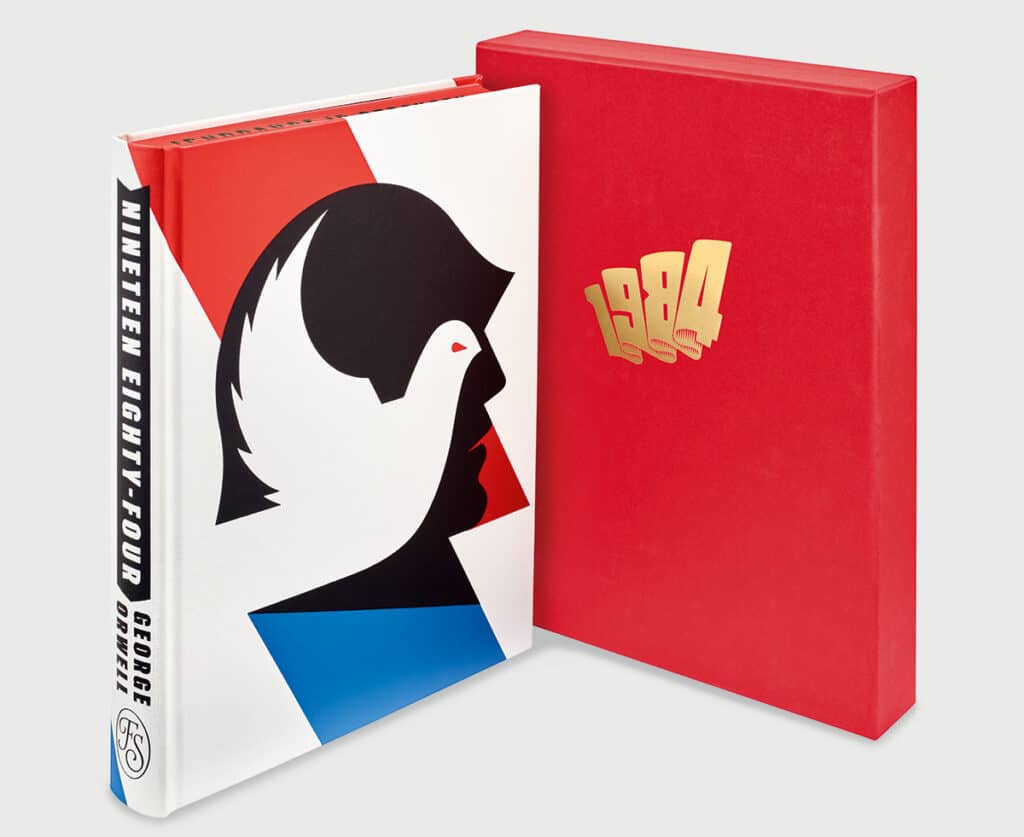
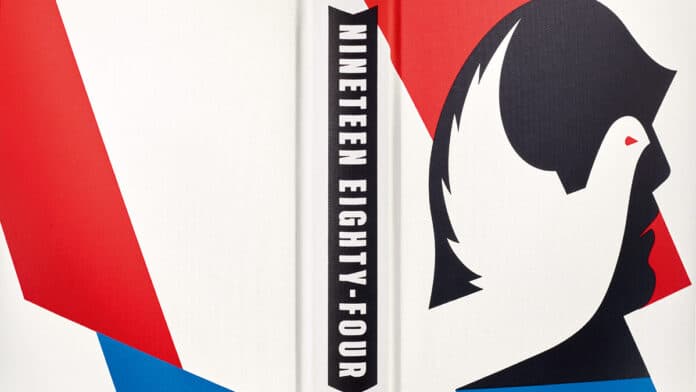
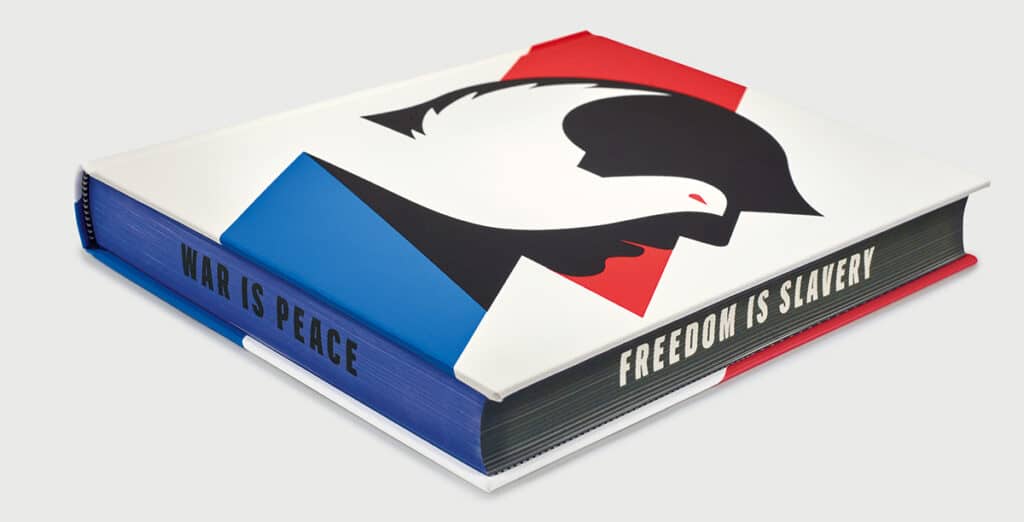
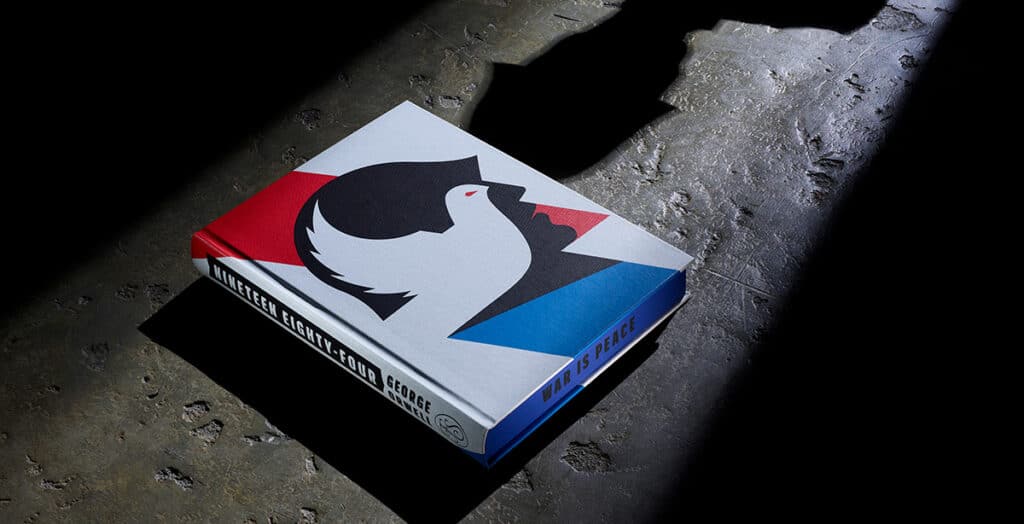
The Folio Society's new edition of ‘Nineteen Eighty-Four' arrives seventy-five years after the author's early death. Revisiting it now, it's clear that the warnings he left behind in the pages of his final work remain as terrifyingly relevant as ever. Artist La Boca, who has previously worked with The Folio Society on titles such as Philip K Dick's science-fiction classic ‘Ubik‘, is the perfect choice to visualise Orwell's work. The book has an impressively bold, striking design, basing the illustrations on black and white mixed with red and blue. Doublethink slogans, “Ignorance is strength”, “freedom is slavery” and “war is peace”, are edge-coloured onto the pages, so you can see Party propaganda whichever way you turn. The all-seeing, unblinking eye of Big Brother observes you as you open the first page. Heavy black and white lines and strong angles recall 1980s design. An old-fashioned television screen in a black and white maze ensures that the illustrations give the novel a timeless quality. This is important, as ‘Nineteen Eighty-Four' is an allegory relevant to any epoch. Last word on the design: as a brilliant finishing touch, take a look inside the case for a neatly buried secret!
For newcomers to the book, ‘Nineteen Eighty-Four' is set in a dystopian near future in a part of the world called Oceania (Orwell wrote it in 1948 and swapped around the ‘4' and the ‘8') in which the world is divided into totalitarian superstates. This reflected the way the superpowers carved up the world at the end of WWII that immediately led into the Cold War. The hero, Winston Smith (so named by mixing the country's wartime leader with the most common English surname) is a low-ranking party member whose function is to erase history, better-enabling the Party to control the official narrative. Winston keeps a secret diary in which he records his growing doubts and loathing of the regime. This is a dangerous act of rebellion when the daily activities of citizens are constantly monitored by the all-seeing Big Brother. As his confidence to rebel grows, Winston embarks on a forbidden love affair with fellow Party-member Julia. But in a world full of spies and deception, Winston and Julia fall foul of the Thought Police. A fate of re-education lies ahead of them…
The slight disappointment with this edition is Elif Shafak's introduction. The Turkish author has experience of authoritarian regimes and provides some contemporary examples of threats to individual freedom and human rights in the digital age. Yet she doesn't acknowledge that Orwell's fable was specifically a criticism of Stalinist Communism – a form of left-wing totalitarianism and authoritarianism. With a focus on contemporary America, which certainly has its problems, she makes no mention of (for example) North Korea that is much closer to Orwell's fictional world. The fabled enemy of the state, the subject of the Two Minutes Hate, is Emmanuel Goldstein. Rising scapegoating should elicit a mention that Orwell chose a Jewish intellectual because of the genocidal antisemitism of Hitler's and Stalin's regimes.
It matters that the author criticised his own side. To many within the intelligentsia, attacking Stalin was off-limits. Orwell was a lifelong social democrat who took a bullet to the neck during the Spanish Civil War fighting Franco's fascists (see ‘Homage to Catalonia'). But Stalin's brutal rule came to horrify Orwell. His moral is that we must be free to say that two plus two equals four, no matter which side of the political divide finds the answer offensive. Beside George Orwell's statue at the BBC are inscribed his famous words, “If liberty means anything at all it means the right to tell people what they do not want to hear.”
Certainly, much of ‘Nineteen Eighty-Four' is uncomfortable. Orwell delivers profound insights into the human condition. The ‘Two Minutes Hate' is a fine example of how mob's can be whipped into a frenzy when given an ideological cause. The overall tone is paranoia, a staple feature of Communist states controlled through the abolition of trust and hope. Orwell finds a way to dramatise how an authoritarian regime forces the human spirit to forego individual liberty, and what replacing it with unquestioning acquiescence to the all-powerful state entails.
‘Nineteen Eighty-Four', written in a hurry with the zeal of a man on a mission to warn the world before his time ran out, remains a thoroughly-enjoyable novel. Orwell was a trained journalist and a skilled essayist. He observed his own ‘six rules for writing' that prioritised clarity. As such, his prose is as fresh and vivid now as it was nearly eight decades ago. I always recommend ‘Nineteen Eighty-Four' to people who enjoy reading, but avoid the ‘classics' because they imagine them to be wordy, worthy, plodding and dull. At nearly three-hundred pages, ‘Nineteen Eighty-Four' is around Orwell's longest work, but I always remember it as a shorter book as it's such a ripping read. A pessimistic story stripped of any levity and replete with horrors (you'll find those lurking inside ‘Room 101') can trouble the mind. But the breadth of Orwell's imagination ensures his perfectly-realised fictional world comes to life from the first page. Saying that ‘Nineteen Eighty-Four' is one of the most important works of Twentieth Century fiction makes it sound off-puttingly weighty (even though it's true). It is perhaps better to say that ‘Nineteen Eighty-Four' is a book you'll never forget.
Having said that, I return to ‘Nineteen Eighty-Four' every decade or so. The first time I read it, in my late teens, I misunderstood it. As I've grown (hopefully) a littler wiser and (certainly) a little wearier, my imagination has interpreted it in different ways. Every time I return I notice different nuances in the text. ‘Nineteen Eighty-Four' is the only book I have ever read more than twice. That it keeps calling me back is testament to the power of the author's ideas and the brilliance of his storytelling. Orwell saw human societies at the end of the Second World War and the likely future with such devastating accuracy that it almost defies belief. His insights were significantly more profound than those of his contemporaries. That's why he matters, and why his work endures.
We can regret that his life ended prematurely, before he could enjoy the success of ‘Nineteen Eighty-Four' and before he could contribute further great novels and essays. But we must remain grateful that, in a draughty house on the Scottish island of Jura, typewriter balanced on his knees, Orwell used his remaining strength and powerful intellect to hammer ‘Nineteen Eighty-Four' onto the page. Perhaps, in writing his prophetic warning, Orwell retained a glimmer of hope such a future for humanity could be averted. Properly understood, a fictional world about the absence of hope may just provide enough insights to offer societies in the Twenty First century an understanding of what freedom means and what its absence portends. So long as there is freedom to defend, ‘Nineteen Eighty Four' remains provocative and powerfully relevant. It will always be a bright, cold day in April, when the clocks are striking thirteen…
Publisher: The Folio Society Publication date: 21st October 2025 Buy ‘Nineteen Eighty-Four'

