

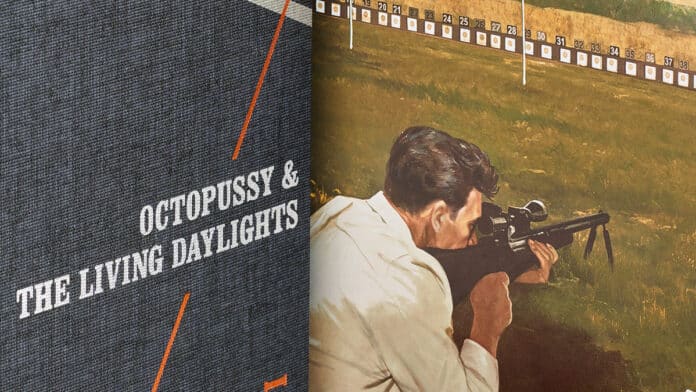

For dedicated collectors of The Folio Society’s James Bond series, the release of ‘Octopussy & The Living Daylights’ is enormously welcome. Its publication finally plugs the gap on the bookshelf, completing the full range of Ian Fleming’s James Bond titles in this range. All fourteen Ian Fleming James Bond books are now available in luxury gun-metal grey hardback edition, with Fay Dalton’s stunning period illustrations embellishing the pages and the slipcase cover.
Originally published in 1966, ‘Octopussy & The Living Daylights’ was released posthumously, following Ian Fleming’s premature death in 1964. It would mark the final outings for the suave secret agent, just as the movie adaptations starring Sean Connery were taking the brand to new heights. The two worlds – the books and the films – would diverge. How closely they followed the source material waxed and waned over the years.
I recall, reading ‘Octopussy & The Living Daylights’ as a child, being baffled by the collection of short stories. Why was James Bond in it so little? Returning to it over thirty years later, I again noted his absence, but this time understood a little better the author's possible intentions. This edition includes ‘The Property of a Lady’ and ‘007 in New York’, short stories that appeared in later editions of the book. The four adventures form a short and curious collection of entries into the official James Bond canon.
‘Octopussy’ sees James Bond visit Jamaica, a familiar location in the novels as the author knew it well, writing his stories at his GoldenEye retreat there. In the story, Bond hunts for and locates Major Dexter Smythe. Years earlier he had murdered Bond’s skiing instructor Hannes Oberhauser to make away with a stash of Nazi gold that they had uncovered together. Once in Jamaica, he had lived quietly on the proceeds ever since. Having located his prey, Bond gives Smythe two options to face justice: kill himself or be court-martialed. The unusually reflective story features very little of Bond, who doesn’t drive the action at all. Rather, we hear Smythe’s backstory and learn of his fate, which provides the explanation for the inventive title.
The short story ‘Octopussy’ bears no relation to the film. However, ‘The Property of a Lady’ details the sale of a valuable Fabergé egg at Sotherby’s auction house that had formed a subplot of Roger Moore’s penultimate outing as 007. Again, Bond’s role is relatively passive. He is there to identify a KGB operative. But that's the extent of his involvement.
The third story, ‘The Living Daylights’, is by far the strongest. I may be a little biased in saying so, as a big fan of Timothy Dalton’s criminally underrated tenure. Keen to take Bond more seriously and return to the literary sources, Dalton provided inarguably the closest interpretation of Fleming’s creation on screen. After the pre-titles sequence, the opening sequences of the film version of this story follows the source material closely, even down to Bond suggesting a sniper could make ‘strawberry jam’ of his victim. But the sniper trying t to take down a Soviet defector turns out to be not just a pretty girl but the cellist Bond so greatly admired when preparing for the hit. Will he obey his direct orders and shoot to kill the target? The story is a great example of the moral ambiguity of the central character, and the unease he can feel in executing an assignment. Dalton’s second film, ‘Licence to Kill’, was strongly inspired by Fleming’s ‘Live and Let Die’ (worth knowing when dealing with those who opine that it’s “not really a Bond story”). His third film was meant to be called ‘The Property of a Lady’, using another title from this collection, but sadly it was not to be…
The final story, ‘007 in New York’, is a few short pages that finds Bond in America looking for a British contact to warn her that she is dating a KGB agent. In common with the other stories, Bond’s involvement is mostly passive and detached from the world of espionage. Instead, we experience the sights and sounds of New York from a sophisticated British perspective – the kind of descriptive prose strong on aesthetics and location that Fleming excelled at. Readers may also be intrigued to learn how to make scrambled eggs – James Bond style!
In pushing the central character to the fringes of the narrative, ‘Octopussy & The Living Daylights’ succeeds in achieving a different approach that Fleming arguably had not attempted since ‘The Spy Who Loved Me’, in which he narrated the story from the first person perspective of the Bond girl. Similarly, this attempt isn’t entirely successful, and the volume is unlikely to be considered many Fleming fans’ favourite Bond book. His other collection of stories – ‘For Your Eyes Only’ – is a richer selection of yarns. Other writers were starting to redefine the espionage genre by the time Fleming's last book came out. By the early 1960s, Len Deighton had crafted the anti-Bond nameless hero of ‘The IPCRESS File' and ‘Funeral in Berlin’, accentuating the drudgery and dirtiness of the world of spies, defections and double agents that Fleming had done so much to glamorise. Bringing to life grim realities of the mechanics of spying is not Fleming’s strength. It’s no accident that the strongest story in this collection, ‘The Living Daylights’, gives Bond a prominent role, an influence on events and an active voice.
Despite some reservations about the overall quality of the storytelling, it is thrilling to add ‘Octopussy & The Living Daylights’ to the collection. Its design is exceptional and pleasingly uniform with the other books in The Folio Society’s James Bond range. Fay Dalton, whose work on the series has been exceptional, meets her own high standards with this edition. There is a double-page illustration of the ‘Octopussy' villain underwater. But her painting of the female KGB sniper (so memorably played by Maryam d’Abo in ‘The Living Daylights’) captures the character and the moment in the story brilliantly, conveying the tension of the defection and the reason Bond hesitates to carry out his orders. The illustrated slipcase cover depicts Bond at a firing range, picking up on the professionalism of the protagonist as he prepares for his mission in ‘The Living Daylights'.
If you’re a collector of The Folio Society’s James Bond books, you’ll want to have the fourteenth and final title for completion’s sake. The story ‘The Living Daylights’ is vintage Fleming, and its importance extends into the world of the films as Dalton’s first outing used it as a springboard for an excellent film that was the last (made two years before the fall of the Soviet Union) to tell a Cold War story – the only epoch that truly suits Commander Bond. There are points of interest in the other stories too, but overall, this isn’t Bond’s most exhilarating assignment. Despite that, Ian Fleming is never anything other than an entertaining writer.
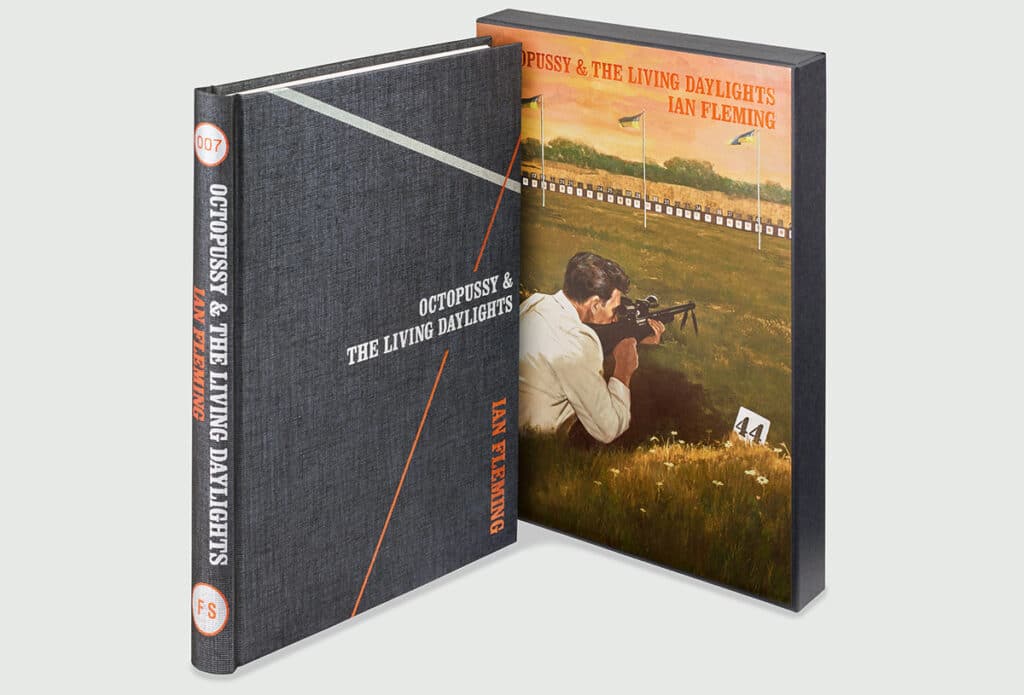
Publisher: The Folio Society Publication date: 16th September 2025 Buy ‘Octopussy & The Living Daylights'

