

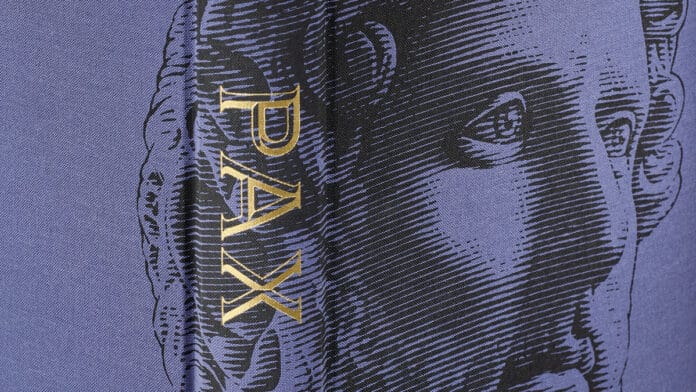

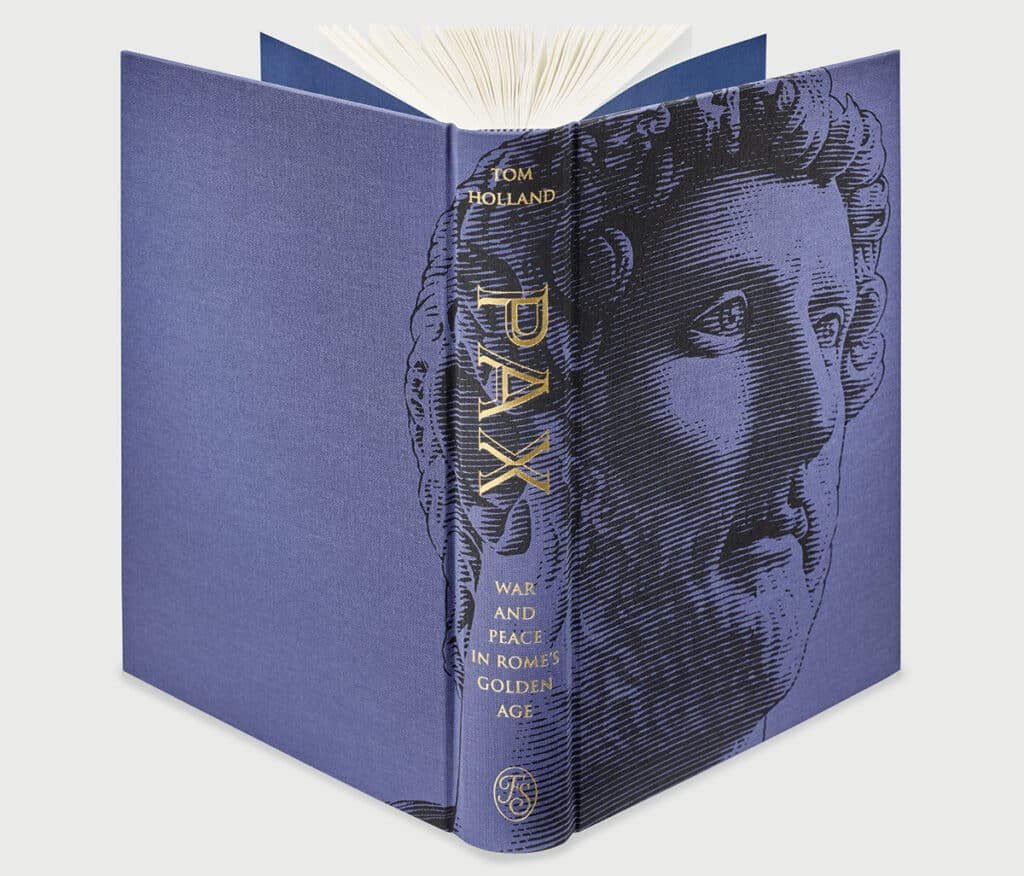
‘Pax’ is the third book from historian Tom Holland’s extensive bibliography to receive an exclusive luxury edition courtesy of The Folio Society. It now joins his magisterial sweep through Western civilisation in ‘Dominion’ and account of the fall of the Roman Republic in ‘Rubicon’.
‘Pax – War and Peace in Rome’s Golden Age’, first published in 2023, thematically follows on from his earlier work ‘Dynasty: The Rise and Fall of the House of Caesar' (2015) that told the incredible story of the first century or so of the Roman Empire under its monarchical system. Those with a penchant for marble busts will recognise the noble face of Hadrian, the early Second Century leader, on the cloth-bound hardback cover. Facial hair in history is important: Hadrian was the first emperor to sport a beard. His reign is the climax of this book. ‘Pax' (the Latin for ‘peace') covers the troubled reign of Nero through to the death of Hadrian, the resulting peaceful succession and the rise of Christianity.
Peace was not always guaranteed. Holland's account begins with the death of Poppaea Sabina, wife of the Emperor Nero in 65 AD. At this point, the Roman world had known internal peace, free from the Civil Wars that had culminated in the assassination of Julius Caesar, for almost a century. But Nero's reign was a troubled one, ending in his forced suicide. With no clear bloodline for succession, the Julio-Claudian dynasty was extinct, resulting in constitutional crisis and the tumultuous Year of the Four Emperors in 69 AD.

Holland's narrative expounds on the idea of peace versus civil strife. Galba, Otho and Vitellius are not household names. The author's chapter on their brief moments of glory brings these often-overlooked, fleeting emperors to life. Their contributions to history are framed as the high-stakes reminder that Rome could be plunged back into the horrors and uncertainty of war with itself. Nothing is worse than Roman-on-Roman violence.
Happily, the fourth emperor of that chaotic year, Vespasian, came to establish the Flavian dynasty. He is engagingly characterised as no-nonsense and pragmatic by Holland. Knowing the importance of keeping the populace entertained, we have Vespasian to thank for the Flavian Amphitheatre (that's the Colosseum to most folk). He makes earlier appearances in the narrative as one of Nero's generals. We then follow through the succession to Vespasian's less-august sons, the short-lived military leader Titus and the cruel Domitian, who stand in natural contrast to the capable leaders who provided peace and stability. The final sections of the book recount the leadership of the first three emperors of the Nerva-Antonine dynasty – Nerva, Trajan and Hadrian. This is the period that the Tom Holland of the 1700s, Edward Gibbon, dubbed the ‘Golden Age', when “the human race was most happy and prosperous”.
Although Holland’s intention is to examine peace and war rather than to document the so-called ‘five good emperors’ – a rare run of competent leaders who weren’t overtly tyrannical or crazy, I lamented that the brief reign of Nerva (the first of this respectable quintet) is dealt with fleetingly. I also craved more on Hadrian, whose remarkable life is crying out for a general readership biography (Tom, if you're listening…). The focus is on his extensive travels and relationship with the beautiful young man Antinuous. A dangling thread in my mind was why Trajan, rather than Hadrian, had been declared Optimus Princeps – the best of rulers – by the Senate, when his military overreach left a bucketload of consolidation work for his successor. This period of Roman history is such a rich vein that it's impossible to cover every angle. It's a good thing to leave your readers wanting more…
The conflict throughout the book lies between expanding the empire through conquest and maintaining law and order throughout the provinces – the ‘Pax Romana' of the title. Roman historian Tacitus' well-cited quotation “When they make a desert they call it peace,” forms the epigraph. But the author has a secondary purpose in ‘Pax', which is to remind readers along the way of what life was like for ordinary Roman citizens, and how they contributed to the overall peace and stability of the empire. There are large-scale events that we stop off to take in. Notably, the eruption of Mount Vesuvius and the destruction of Pompeii and Herculaneum in 79 AD. This captivating passage details the unravelling of the disaster that led to the death of the author Pliny the Elder. In his typically vivid descriptive style, Holland describes his corpse as looking “deeply, dreamlessly asleep”.
History echoes down the ages. ‘Pax’ will resonate with readers now for its descriptions of Roman activity in Judea, modern-day Israel, during the First Jewish–Roman War conducted by the first two Flavian emperors. Holland describes Titus’ devastating destruction of the sacred Temple of David and also the siege of Masada, after which the remaining Jewish population committed suicide en masse rather than surrender to the Romans. He later recounts Hadrian’s activities in the region, the consequences of which reverberate to the present time. Such passages ably illustrate the importance of understanding history, and appreciating how human activities in earlier epochs have shaped our current world and influence us still. A major strength of the book is that the author does not lose sight of the impact of that major or traumatic events have on ordinary people caught up in them. Holland achieves this through meticulous research and attention to detail. The book is full of relatable moments.
‘Pax’ has a special place in my heart as it was my gateway back into Roman history having studied classics at university a quarter of a century ago. My interest had remained on a low simmer in the intervening years before my husband gifted me ‘Pax’ when it was first published. What is it about men in their 40s becoming obsessed with either the history of Rome or WWII? Since reading ‘Pax’, I’ve dragged my husband to Northumberland, Rome, Tivoli and Jordan to follow in Hadrian’s footsteps (“Not more rubble!”). Possibly he now regrets the thoughtful, fateful present in 2023, though Holland keeps me out of trouble. I’m now also a voracious listener to ‘The Rest is History’ podcast, which Holland co-presents, and am gradually working my way through the author's back catalogue.
Sliding The Folio Society’s edition of ‘Pax’ out of its slipcase and taking in the exquisite attention to detail is a wonderful experience for fans of the book. The maps printed in the original have been recreated for this edition, and the colour photographs expanded upon. They pick out excellent descriptions from the text such as details from Trajan’s Column of Roman auxiliary soldiers offering decapitated heads of the Dacians to the conquering Emperor. The three sections of glossy photographic inserts are well-spaced throughout the pages and augment the author’s prose.
On a second reading of ‘Pax’, I was once again impressed by the brilliance of Holland’s prose. He is a natural storyteller and entertaining, enjoyable writer. This is enough on its own to thoroughly recommend ‘Pax’ to readers who enjoy non-fiction history but who don’t know much about the Roman period. For those who love reading Roman history, ‘Pax’, as with Holland’s other titles covering this subject, is essential reading. The Folio Society’s stunning new edition, released as part of their Autumn 2025 Collection, will be a stand-out addition to any bookcase.
Publisher: The Folio Society Publication date: 16 September 2025 Buy Tom Holland's ‘Pax'

