

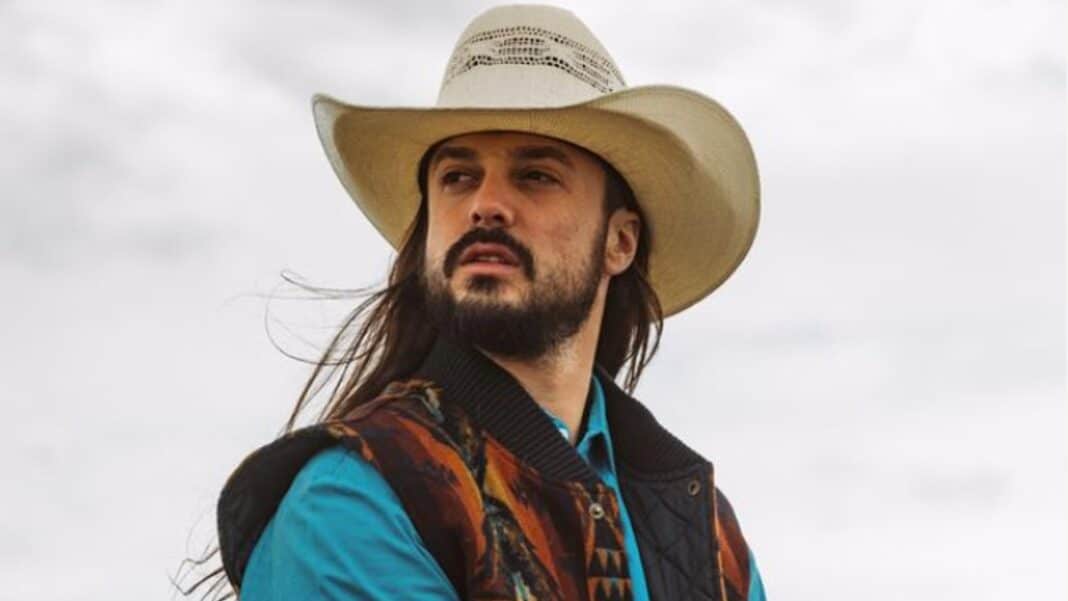

From the wide-open plains of Wyoming to the national country stage, Ian Munsick has carved out a space all his own. Raised on a ranch and deeply connected to the rhythms of western life, Munsick’s music is a reflection of his roots—rich in storytelling, fiddle-laced melodies, and a reverence for the land that raised him. With his debut album ‘Coyote Cry' and follow-up ‘White Buffalo,' he captured hearts across the country, blending the rugged soul of cowboy culture with a fresh, forward-thinking sound that feels as authentic as it is innovative.
Now, with the release of his new album ‘Eagle Feather' Munsick takes his artistry to new heights. (Our review right here) This record is more than just a collection of songs—it’s a spiritual journey, a tribute to Wyoming, and a powerful statement on heritage, family, and identity. Stripped of some of the playful edge of his earlier work, ‘Eagle Feather' instead delivers a deeper, more introspective Ian Munsick, offering a rare country album that resonates on every level. In this interview, we sit down with Munsick to talk about his creative evolution, the meaning behind ‘Eagle Feather' and why the cowboy spirit still matters today.
Thank you for your time today Ian, I know how busy you must be in the lead up to the ‘Eagle Feather' release……
Of course! My pleasure.
Before we dive into the new album – can you sum up what the ‘White Buffalo' era or phase did for you and your career as that period comes to an end now?
Oh man! That album really solidified me as a unique artist in Country music. My first album, ‘The Coyote Cry' put me on the map a little and put me on the radar but ‘White Buffalo' really showed people who I was and what I stood for.
You played with some huge artists like Lainey Wilson and Morgan Wallen during that phase as well as playing lots of your own headline shows. Which artist impressed you the most in terms of connecting with their fans, looking after their crew and being graceful to the support artists?
That's a good question. All of the artists have impressed me. From Lainey I learned just how quickly things can happen. Two or three years ago she was playing for a couple of hundred people and then last year it's 20,000 people! With Morgan, I learned that the sky is the limit. We sometimes put a roof on how high we can go in Country music but he climbed right over the roof and went completely mainstream.
The person that I learned the most from was Cody Johnson. He took me out before any other artist did and I'm still playing shows with him. All of his band have been with him for years, his crew guys have been there for years too. People only stay because they are treated really well and they believe in the artistry of the guy at the top too. He's incredible.
We've just had Cody over in the UK making his debut. You next?
For sure, I would love that. Hopefully it will happen in 2026 – we'll be over there. He played the C2C festival, right? We would love to do that, it looks like a great event.
Tell me the significance of the ‘Eagle Feather' concept for the new album.
When we headlined Red Rocks in Colorado for the first time last year I got adopted by the Crow tribe. You know, I grew up on a ranch in Wyoming and the Crow reservation was only about a ten minute drive from us. Being adopted into that culture was a magical experience for me and an honour that I will always have for my whole life.
Once you give that gift of love, if it's true love, you can never take that back. One of the presents that the tribe gave me was a golden eagle feather – that's a huge honour because in America it's illegal to own one of those unless you've been presented one by a native American clan. I thought given that I am a voice and representation of western culture I thought ‘Eagle Feather' was the perfect album title for this project.
You wrote ‘Eagle Feather' with Stephen Wilson JR – we love him over here in the UK.
I did! He's an awesome guy.
Tell me more about the writers on this album because I can see credits for Randy Montana, Stephen, Jacob Davis, Trannie Anderson, Caitlyn Smith – those are some big names. Was there any one writer you connected with more than the others?
Oh man. Probably the person I've written the most with would be Jeremy Spillman and he's also a co-producer on the album with me. I've written tons of tunes with him. He's from the Kentucky area and had some big writes with the likes of Eric Church and Ashley McBryde – in that whole realm.
The first time we wrote together we really hit it off. He has a language that naturally just comes out very poetic and I love going to him with ideas. He has a Kentucky way of looking at things that works well with where I'm from in Wyoming as I try and educate and spread the word about western culture.
Which song on the album was the easiest to write and which one took the longest to get it to where you wanted it to be?
That's a good question. One of the easiest was ‘Feather in my Hat.' I wrote that with Caitlyn Smith and Marc Scilbila – Caitlyn is incredible. I had the idea for the song in terms of us both wearing feathers in our hats but the main point i was trying to get across was that the feather is not just a trophy, it's a statement about who you are and I loved the idea of love in that song that went with it – the person you love not just being a trophy too.
There's a lot of people in life, more so in Lainey's, that might view being in her life as a trophy and be focused on what they can get out of that so the song was a gentle reminder of what real relationships are made of.
How did you ask Lainey to be involved in that song and were you nervous about approaching her?
We were on tour together and playing in New York. I had two songs that I thought she would be great for – ‘Feather in my Hat' and ‘Stampede.' I texted them to her and she came back saying that she loved both songs! (laughing) She took a few days to see if one spoke to her more than the other and it was ‘Feather in my Hat' that she related to more in the end. I can see us both performing that song on a huge stage during an awards show – so I'm excited to see what we can do with that song.
Tell me about ‘Made Her That Way.' It's your one solo write on the album so that song clearly means a lot to you.
I wrote that song when I was just thinking about my wife and how perfect she was and how perfect she still is! I started to wonder whether I might have changed her from the way that God made her – people change according to the relationships that they have over the course of their lives – God made her perfect and I started to wonder whether I had changed her in ways that God hadn't intended? It's a heavy thought, right?
I used to write a lot alone but since I moved to Nashville and have had the world's greatest writers just a phone call away I've leaned on them for ideas and inspirations. There's a lot of ideas and ways of doing things that I wouldn't have thought of that they have helped with and I've loved blending my ideas with theirs but ‘Made Her That Way' felt like a very personal song so I wanted to keep it as real as possible. The lines are very real to mine and my wife's story.
Talking about real – you've also got ‘Caroline' on the album and you end the whole project with ‘The Gate' which was never going to go anywhere else on the album than in that last spot was it?
(laughing) Yeah, man. That song was the last one I wrote for the album too – I wrote it just two or three days prior to going into the studio. When I wrote it I knew it was going on the album and it would be the last song on there. There's an expression we have on the ranch where we say that you leave the gate as you found it – so if you find it open, leave it open so that the horses and cows can get out and if it's closed, leave it that way too.
I want people to know that I am an authentic writer – that I live what I write about and that I am passionate about bringing the western lifestyle and values into mainstream Country music. ‘The Gate' does that and is a perfect way to close down this album.
You have all these heartfelt personal songs and but then a song like ‘Firewater' feels like it came from the same creative place as songs like ‘Cowshit in the Morning' and ‘Barn Burner'.
I love that! (laughing) Yeah, man. There's always a few songs on the album where you channel a time that is not now or you tell the story of people that aren't you but that you know of. There's plenty of people in Wyoming and Montana and through the west in general that are having their land bought up and taken away. ‘Firewater' tells the story of that through the eyes of deception – people who are pretending to be one thing but are secretly something else in order to gain the land – it's a classic western tale.
Which song that the fans haven't heard yet are you most excited for them to hear? I think they'll love ‘Stampede,' I think they'll love ‘Firewater' and I think they'll love ‘Wolf Creek Road' as well.
Oh man. That's another song that is just 100% real. I wanted all these songs to be real experiences that happened. I was driving late at night with a couple of my buddies and we had had something to drink and I took the curb too fast and rolled my truck. My dad had to bring me home and the next day he took me back out there and showed me where the cross on the road was. I got chills because that could have been me and that's such a common experience, right? Being 18 and doing something stupid and idiotic.
I think people will like ‘The Gate' as well because there is a lot of emotion in that song that points back to the Country way of life too.
You've talked about being a representative for western culture. Cowboy culture has been very popular in the mainstream now for a couple of years in terms of TV shows, fashion, jewellery etc. How does that sit with someone like yourself who actually lives the lifestyle?
Man, I think it's great that people are now, more than ever, curious about that way of life. As long as people are curious and want to learn more about it I think that's a great thing. At the same time, it means that I have a responsibility now to show what the west is actually all about and it's not just about a cowboy hat or how you dress. Western culture is not about superficial things like that – it's about how you treat your neighbour and how you interact with the land that you live on. ‘Eagle Feather' is all about that.
You have a very busy spring and summer of shows ahead. At this point in your career is it better for you to get on a big tour and play arenas or is it better for you to play your own headline shows where you can delve into your own catalogue more?
Man, we always talk about that. There's times where both of those things are great. It's always an honour to get asked to go on tour with another artist but then again, doing your own shows means more. I learned this from Cody Johnson, who did it the hard way but it proved to be the right way because you do need to build your own fan base.
You can go play a festival or open up for the biggest artist in the world but at the end of the day the people that paid are there are to see someone else. Then it becomes about how many people there can you make fans out of? The longevity comes in when you are headlining your own shows – when you are proving to the industry and to your own fans that you can hold your own on a stage for 90 minutes and people will leave thinking that they just witnessed an awesome performance. I will always err on the side of headlining my own show.
Check out our review of Ian Munsick's fabulous new album ‘Eagle Feather' right here.

