


Although he died over 2,000 years ago, the writings of Marcus Tullius Cicero continue to influence and inspire. Only a few generations ago, the name of ‘Cicero' would have loomed much larger in the national psyche, especially among those who received a classical education. You may recognise snippets of Winston Churchill's great wartime speeches, or recall those electrifying moments in the movie ‘Darkest Hour' when the words he spoke at the dispatch box roused MPs and changed history. There was a man whose rhetorical flourishes and ability to enrapture and persuade an audience started with an appreciation of Cicero during his youth.
Cicero was the greatest orator in Roman history, born into the upper echelons of Roman society at a time when the Senate (the ‘S' in ‘SPQR') was still the final word in how that great civilisation governed itself. Cicero lived and died during the tumultuous period of the Late Republic, which consisted of decades of brutal civil wars and civic unrest. As a period of history, it's thrilling to study. To have seen it unfold first-hand must have been quite another matter. ‘Cicero: Selected Letters & Speeches' offers vital access to one of the most significant figures in Roman society at a critical juncture in its history. This remarkable book is an eye-witness account of some of the most important events in western history.
Many of the Romans familiar to everyone are present in this book. There's Julius Caesar, of course. I write this review on the eve of the Ides of March, the day in 44 BC on which Caesar was assassinated. That infamous moment features within the pages of this book. Cicero, no fan of Julius Caesar, comes close to braying about his ideological opponent's death. You'll find letters to Brutus, one of the key conspirators and knife-wielders when Caesar was hacked to death.
Inevitably, this magnificent tome, spanning over 600 pages will appeal most strongly to classicists and other history enthusiasts. Those invested in public speaking or with a desire to enter the arena of politics and public debate ought also to take a keen interest in this book. ‘Cicero: Selected Letters & Speeches' would also be a remarkable gift to any young person looking to enter the legal profession. In his speeches to the Senate, Cicero acts both as defendant and prosecutor to public figures involved in conspiracies. These speeches are brimful of powerful rhetorical persuasion.
Classicists who collect other editions of the great works of antiquity, such as the Loeb Classical Library and the Penguin Classics, should seriously consider delving into The Folio Society's range, as the publisher has historically not neglected these works. The final sections of this book, which publish Cicero's letters spanning 51 – 43 BC, are translated by the late, great David Roy Shackleton Bailey, whose translations from the Latin were also used by the Penguin Classics' ‘Selected Letters'. The speeches are translated by DH Berry, whose work was previously published by the Oxford World's Classics. What you read has been distilled from a much larger canon by the University of Oxford's Dr Andrew Sillett, who also provides a well-written introduction to Cicero's life and some useful context for each of the four parts.
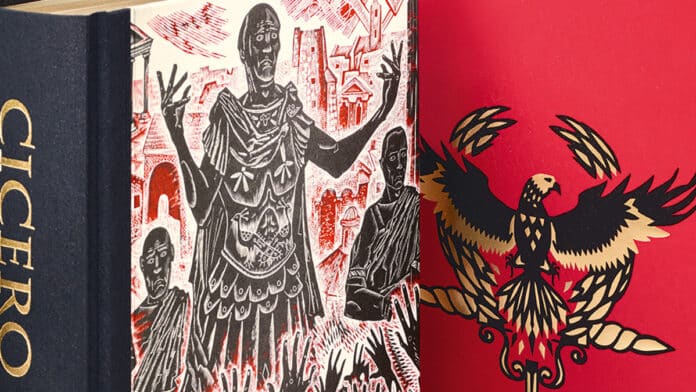
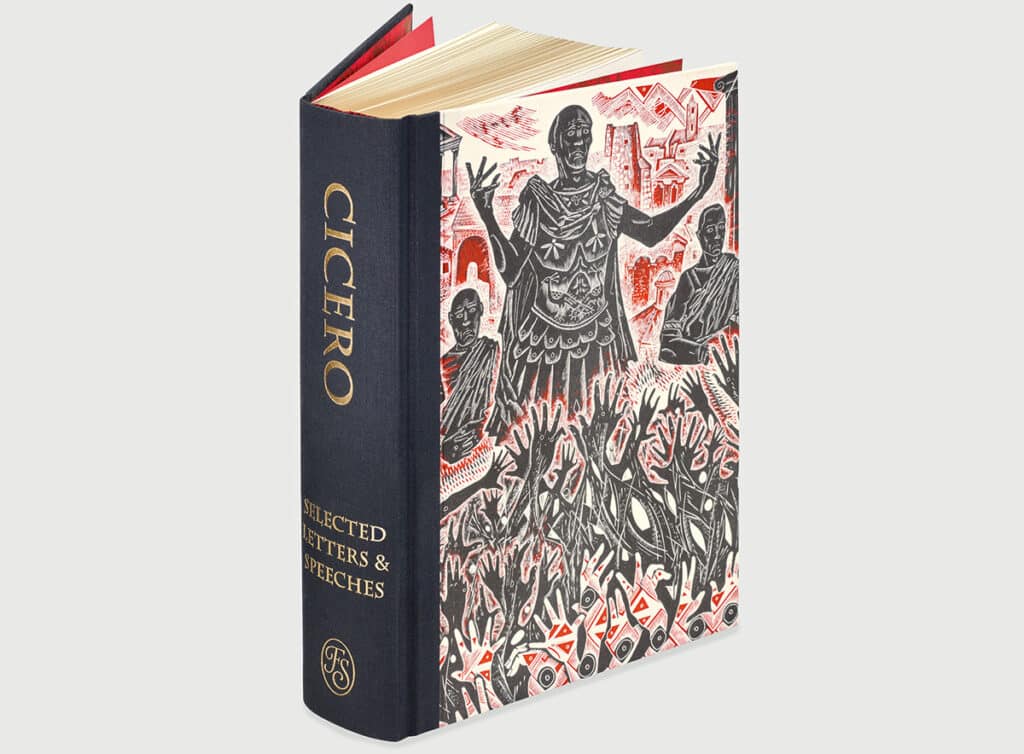
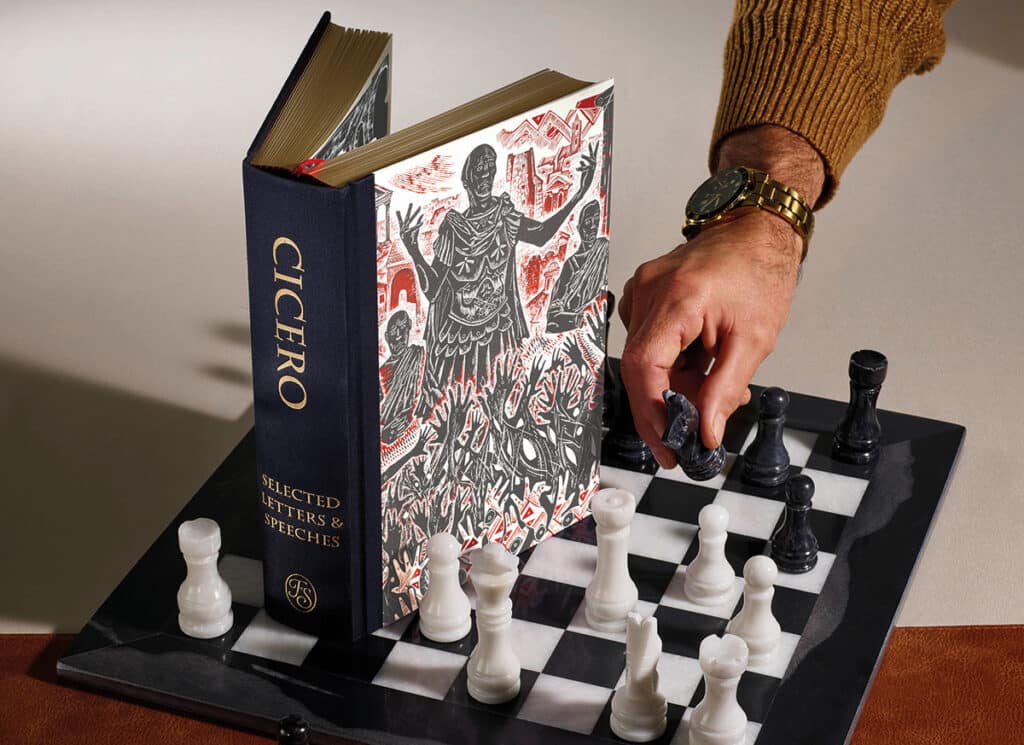
The timeless text is further enhanced by brilliant Neil Bousfield illustrations that take their inspiration from Roman frescos. They also have influences such as the geometric shapes found in the etchings of MC Escher and the dramatic poses and heightened violence associated with German expressionist cinema. The hardback book comes in a red slipcase that has been emblazoned with the emblem of the Roman Republic so beloved of Cicero, making it a wonderful choice. The top pages have been gilded, and there is a ribbon bookmark so you need never lose your place. As always with The Folio Society's books, the attention to detail is sublime and well-considered. This volume even includes a two-page map of Cicero's Cilician Province, where he served as Governor and which is referred to in his letters.
No review would be complete without picking out a few favourite passages. The speeches contain all four Catilianarian orations, in which he thunderously condemns the senator Lucius Sergius Catilina for attempting to overthrow the Roman Republic. The so-called ‘Catalinarian conspiracy' was later written up by the Roman historian Sallust, but Cicero's speeches give us a first-hand account and contemporary insight into an event that shook the Roman establishment to its foundations. “How far, I ask you, Cataline, do you mean to stretch our patience? How much longer will your frenzy continue to frustrate us? At what point will your unrestrained recklessness stop flaunting itself?” These are the opening lines of the first speech and give an indication of the tub-thumping eloquence with which Cicero directed his ire against a fellow Roman statesman. For the merciful side of Cicero, enjoy his speech ‘Pro Marcello', in which he defends the exiled Marcus Marcellus, one of Julius Caesar's enemies. Remarkably, this plea for clemency was delivered in the Senate in front of Caesar himself, who was no stranger to dealing death to those who opposed him.
Out of the letters, you can find Cicero'c correspondence with family members as well as with major statesmen of the day. The very first is to Pompey the Great – a man who, along with Julius Caesar and Marc Antony, dominated the political power struggle. Though he would outlive Cicero, Pompey later ran up against Augustus Caesar as the Roman Republic fell. The letters last right up to the end of Cicero's life. His death came only a year after that of Julius Caesar's. At the risk of spoilers, I'll say only that the two events are not unconnected, and Cicero really was at the forefront of the seismic collapse of the Roman Republic and paid a high price for his ideals. This book delivers an unflattering portrait of Julius Caesar that arguably offsets some of the hagiographies that have been published since, and gives an alternative view to Caesar's memoirs, ‘The Gallic Wars'.
Returning to Cicero's speeches and letters after an absence of a few decades has made me appreciate the man and his place in history with fresh eyes. His idealism, clinging on to the concept of a Roman Republic as the great tide of history turned against him reveals a man of great dignity and sincerity who always held the strength of his convictions. He was a powerful writer, too, capturing for posterity an accessible and detailed first-hand account of a period of history that has fascinated every generation since. But he's also distinctly human, with some obvious foibles. There's a touch of arrogance and pomposity, and even a pig-headed stubbornness. Yet it's his authenticity that keeps us on his side.
Reading the words of Cicero is the best way to transport yourself back over two millennia and hear for yourself about the events that shook the ancient world. There were few of Cicero's contemporaries who could match his brilliance as a writer, let alone equal his historical significance. The Folio Society's ‘Cicero: Selected Letters & Speeches' is a title that would be the crown jewel of any book collection.
Publisher: The Folio Society Publication date: 4th March 2025 Buy ‘Cicero: Selected Letters & Speeches'

