

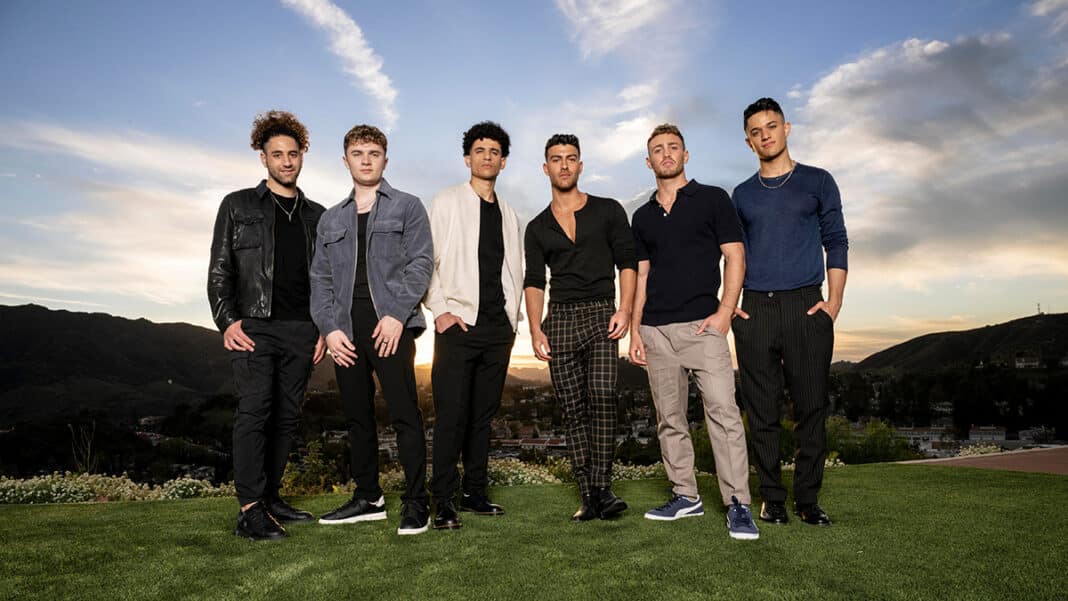

If you've not heard of as1one yet, now's your time to get acquainted with the talented six-piece group.
The world first Israeli-Palestinian group, as1one consists of Ohad, Aseel, Nadav, Neta, Niv and Sadik. The group is the focus of a new Paramount+ documentary that explores how they were formed and how they've come together against the backdrop of the Israel-Hamas war. Ahead of the documentary, the band released singles ‘All Eyes on Us' and ‘Stranger'.
I caught up with as1one to talk about the challenges of forming and being in the group, discuss their documentary series, and to find out what their hopes for 2025 are…
The documentary has just arrived on Paramount+ and it shows the process of how you guys became a band. It was a very long and gruelling process. What was that experience like for you?
Ohad: We have six different stories. We all started in different places. It was a long process of auditions, a year of auditions to get to the group. It started with around 2000 people, then it (recduced to) a few hundred, then into the last hundred. The final 20 guys went to a bootcamp in a village in Israel called Oasis of Peace. In the bootcamp we were practicing dancing, recording and (socialising) with each other. It was a very like intense week for all of us. It was very fun, just 20 super talented guys together singing all day. After two months, we got the results that we were in the group.
Aseel: It was a very intense two months.
Ohad: The hardest.

The documentary really shows the highs and the lows of your journey together. Azeel, you're a rapper and a dancer and you bring something completely different to the group. How did you make that work within the group dynamic?
Aseel: First of all, it's really amazing to have this opportunity to, first of all, learn from them. I am a rapper and a dancer that didn't sing before and right now I'm surrounded by singers and by really good singers that I'm listening all the time. These runs that Nadav does and Ohad with his guitar. It's really great to learn these things, but at the same time, it's adds a bit of spice to the music that we make when you (add) rap, because it makes it more energetic. If it's dancey, then I can dance to it and then you have some kind of sexiness to it so it's really nice. I believe the more music we make, the easier it will become for us to mix all of our different backgrounds, because each of us comes from a really different background in music. (When we) bring it together it becomes really beautiful.
With every band there's always a struggle when it comes to line distribution and each person feeling like they are showcased properly. In the documentary we see that some group members are worried they don't have enough lines. It's a challenge to showcase six people in a three-minute pop song. How did you deal with that Niv?
Niv: At the beginning we had different experiences being in a studio. For me, that was a learning process. Every day we'd been recording a different song for a few months, which was crazy and very new for me. I've learned to understand that we're six guys; we have different tones and different voices. For each song, some of our voices fit better. It takes time to understand (that) and to (let go) of the ego and to understand you're not individual anymore; you're in a group and you've got to think (what's) the best for the group. I'm in a different place and I've learned so much.
There's another point in the documentary that really struck me Sadik, where you're in the recording studio and for whatever reason that day, you were just struggling with it and the pressure. How do you work through that?
Sadik: To move to LA, everything here was very new to me so it was a lot of pressure on me. (In that moment you mentioned) I really didn't care for the cameras. I didn't care for the studio. I didn't care for anything. I just heard my thoughts and I just did it. It's not easy to leave my home suddenly and be surrounded with the guys and doing only music 24/7. It was very new to me and a lot of feelings mixed together. With the parts in the songs, I wasn't really understanding how that goes. Sometimes (I didn't feel that I was) getting enough and sometimes (I wasn't) singing sometimes. That was a lot of emotions (and sometimes) that's what happens.
The situation you guys have been in isn't natural and it's a hard thing for anyone to cope with. As the documentary starts you're all very excited but as time goes on, you can see that being followed becomes tougher. What was the experience like for you Neta?
Neta: It's weird because at first it's very jarring to be on camera at all time because you're in this loop of ‘ am I acting natural enough? Do I need to act more natural?' and then you get really tense and stuff. As time went on, we got used to the cameras and it got a little easier. What we went through was something very, very intense, being here in L.A. right before the war, arriving here and living so far away from home; to have that all on camera, it was very intense. I think it never got easier or harder. It's tough sometimes because you want your privacy and you want to let your hair down for a second and take a deep breath. Looking back, I see all the moments that they captured, like the moments they caught us having as a band and I understand it now. I get why they were filming all this time and why they wanted to capture every moment to make sure they didn't miss anything. It was for a good cause and for a good reason, and it turned out amazing. I'm really excited. It's going to be crazy to see us on the screen on Paramount+ and have this all come to fruition.
Something else that really shines through in this documentary is just how important family and friends are to all of you. Nadav you're on the phone to your mum quite a lot during the documentary and it feels like your mum was your anchor through this whole experience. How important was it for you to lean on your family during this time?
Nadav: It's the best gift I could ever had, to have my family supporting me so much. Music was my dream for my whole life. I say it a lot that but I've been singing before I started to speak. Part of the reason I was able to chase that dream is because of my family that supported me throughout, no matter what. I feel like all of our families really support us and the families of this group are incredible. It's became like one big family. Every time a family member comes to visit, if it's my mom, if it's the Ohad's mom, if it's Niv's mom or Neta's family or Aseel's or Sadik's, it's a big family. (We're) brothers. It just feels like home all of a sudden again, and it's great.
As well as the documentary you have a 5-track self-titled EP coming. Why did you choose these songs to showcase as your first body of work?
Ohad: These five songs, you can hear them all over the docu- series and it starts with ‘All Eyes on Us', which is our first single and it features Nile Rodgers. This song is very important for all of us because it had a really beautiful journey. We started recording it two years ago back in Tel Aviv and then we flew to Abbey Roads in London, where we first met Nile Rodgers. That was a crazy experience, just seeing him and be ing able to have him on our track. Then we flew to L.A. and recorded some more (for it) , so this song (was created across) three countries. I think it really talks about our journey as a group. The other song that we have on the EP recorded here in L.A., ‘Stop the World', was probably recorded on one of the worst days of our lives.
Niv: I think each of our songs has a different meaning for each of us. When it comes to ‘Stranger' or ‘All Eyes on Us', everyone has this deep meaning, especially because we (moved to L.A.) on October 6th and what we've been going through (since then). It's a lot. It's not easy being Israeli s and Palestinians here in that situation. What I can say about the music we've created is that's what helped us to heal. That's what helped us to stay together and to keep on going and to believe in what we're doing here.
The documentary has the backdrop of the war, which has obviously caused tensions within the group and you've had to work through a lot of differences to continue. It must have been quite challenging to have those discussions and come to an understanding. How did you manage to do it?
Neta: We come from such different backgrounds and we were raised differently. Beyond being Israelis or Palestinians, we are all very different individually with different values that we were raised on. To find that common ground took a lot of listening and a lot of patience. It really taught us how much patience, listening and open-mindedness is such an important tool at a time like this. We just hope that as a band, maybe other people could take some inspiration from this. We could really inspire people to be more open-minded and to hear more stories from actual Israelis and Palestinians like us and hear what it's like to be Israeli and Palestinian together at a time like this, during this journey that we're on making music and being a band.

Have you been surprised by the reaction to the band and how supportive people have been so far?
Aseel: It hasn't really surprised us, it has given us a lot of hope. One of the reasons is because as humans in the world, we all want peace and we all want to build things together and live. This is something that most people resonate with when they see us and they see what we want to do. In the end, we want to come here and make music and show how music brought us together and show that it is possible to come together, even though we come from very different backgrounds with very different opinions at times like these. We still find common ground that we can start talking about and then continue to move on to our differences and accept them. When us humans have empathy, it's just the best thing that we can ever have. You see it, you start having the same emotions as the person in front of you and you start having the same hopes. People see our hope and they see the things that we want to show to the world, and they feel the same. It hasn't really surprised us, but it has been amazing and given us a lot of courage.
The example you're setting in regards to tolerance and unity in a world where social media is driving society apart is admirable. You have the opportunity to influence those younger generations and I can see your social media posts are already getting great engagement such as the videos of you playing your songs to strangers in the street. How have you found engaging with that younger demographic on social media?
Nadav: It's amazing to see that we give hope for people and that people really connect to us. Of course, we knew that there would be some negativity around it because it's natural; we're doing something that is a little bit controversial. Overall we really see the positive in it because the younger audience (send us) a lot of DMs. We get a lot of messages from people that say how we should keep going and how the music is amazing and gives them inspiration. This is the goal at the end of the day, to give inspiration to people and to let people enjoy really good music with a message, and sometimes without a message; sometimes it's just a really good pop song. We try to give it all so it's amazing to see their reaction and the positivity around it. We're grateful.
In the documentary you play your first live show. Are you making plans to start touring and will the UK be a part of those plans?
Aseel: We have a lot of plans – a lot of plans – and hopefully one of them is touring. We're really excited. You saw at the end of documentary, we performed for our parents. It was really beautiful because it felt, first of all, that we are finally coming together, going up on a stage and singing, and also singing for our families, who we didn't see for a long time. We are really excited to do the same thing for people all around the world. This is going to be a big plan for us.
Neta: There's just so much coming and this is just the beginning. We can't stress it enough that this is just the beginning,
Nadav: We can't wait to go back to London!
You've achieved so much already and been working so hard behind-the-scenes. You must be desperate to just get your music out there and start playing live?
Niv: I come from the basketball world. Being on the stage in basketball, it's being on the court and it's the most exciting part for me. I remember we went on the stage back home in Israel, we felt that bonding moment for us and we felt so connected to each other without even talking about it – just singing together. We felt so good. It's something that I think we're looking for ward to and working on already. We want to share and show our happiness despite all the challenges to the world.
What would you like 2025 to bring you?
Sadik: Joy.
Neta: We're just getting started and once this ball start s rolling, we want people to hear about us. We want people to hear our message, to hear our story and to really resonate with it.
Nadav: I can really relate to that. We worked for more than a year on music, but we've been together more than two years already. We can't wait to see the fruits of everything and see people react to it. I think 2025 for us, we'll promote everything we did this year and hopefully to reach a lot of people.
as1one's Paramount+ documentary series, ‘as1one: The Israeli-Palestinian Pop Music Journey', is available now as are their singles ‘All Eyes on Us' and ‘Stranger'. Watch a performance of ‘Stranger' below:

