


Classicist Mary Beard has built up a dedicated readership through her many best-selling Roman history books. She is fast becoming a national treasure. A familiar face on television thanks the documentary series she presents, she brings her specialist subject to life for a much wider audience. There is something about Ancient Roman culture and its influence on western civilisation that continues to fascinate us. Few academics are as good as Mary Beard at unpicking the appeal of our ancestors. In ‘Emperor of Rome', she examines the Romans' remarkable past and connects their lives and stories to the present.
Her previous book, ‘SPQR‘, which is also available in Folio Society edition, took readers on an exhilarating journey back in time to the origins of the Roman Republic, a period in the history of Rome that tends to be overlooked in favour of the arguably more exciting and scandalising period of the early Empire that came afterwards.
With ‘Emperor of Rome’, an instant non-fiction bestseller when it was first published last year, Beard presents her readers with a more holistic view of Roman society, mostly from the perspective of the upper echelons of its society. The book is not a chronological narrative tracing the succession of emperors. Rather, intriguing stories from the reigns of emperors embellish or explain the wider thrust of her narrative. What went on inside emperors’ palaces? What did the populace make of their rulers' grand building projects? What did they eat inside the royal court? How did emperors handle the thorny issue of succession and ensure a bloodless transition of power? How did they relax? How did they maintain their empire at home and abroad, and what image of themselves did they try to convey to their subjects? Why did the games inside the Coliseum and Circus Maximus put emperors under a microscope in front of their subjects? Finally, how did they do their best to die well and be remembered favourably?
‘Emperor of Rome' is a fascinating, thoroughly engrossing and accessible book that is a must-read for anyone with an interest or passion in the subject matter. I tried to imagine as I read Beard's narrative whether or not it would all make sense to a reader with little knowledge of the period, but who is looking to find out more about Roman history. I'd say ‘Emperor of Rome' isn't the right book for beginners. Tales of individual emperors are anecdotal and jump back and forth through the centuries. A thematic rather than linear approach may leave novices all at sea. Although Beard always endeavours to explain her subject, there is an assumption that readers will have some level of knowledge. However, those who have already read ‘SPQR' will find ‘Emperor of Rome' a natural successor, and every bit as thrilling.
Even for readers who have a keen interest in Roman history, there are likely to be stories contained within ‘Emperor of Rome' that are new, or at least presented in a different light. The book opens with an account of how Elagabalus, briefly emperor in the early Third Century, used to amuse himself by holding themed dinner parties, such as inviting only bald or bearded senators. The youthful ruler, remembered largely for his interest in pushing the boundaries of sexual norms and behaviour, is hardly a household name. He is useful to illustrate the point of how not to rule, as the next few chapters uncover what made for good leadership in Roman times.
Better-known and -respected emperors are connected to familiar landmarks throughout the pages. Trajan is regularly referenced. The sight of Trajan's Column in the centre of Rome, close to the remains of Trajan's Market, helps to ensure that perhaps the most successful military emperor is well-remembered, and Beard unpacks his considerable legacy. Photographs of his statues, coins and monuments help to bring his story to life.
I was lucky enough to recently make a return visit to Tivoli, a short journey outside of Rome, where the majestic remains of Hadrian's Villa can be visited to this day. Beard describes the name as “a glaring understatement. It is more like a private town.” Chapters later, she returns to the subject, divulging details about the elaborate, labyrinthine construction of the emperor's “sprawling private town” such as the underground passageways that servants would traverse so that they didn't bump into the wealthy and influential visitors in the corridors. I wish I had read this book before visiting, as she brings to life the opulence and luxury of high Roman society in a way that bare brickwork cannot. She describes too the origins of the Domus Aurea – Nero's famous ‘Golden House', with its alleged revolving dining room, giving readers an appreciation of the ingenuity and craftsmanship of Roman engineers, architects and builders.
Many of the best-known emperors are weaved into Beard's narrative. There are frequent references to Augustus, Trajan, Marcus Aurelius, Vespasian and Hadrian on the side that history has remembered favourably. Domitian, Caligula, Commodus, Nero and Elagabalus represent the madder, badder end of the spectrum of Roman rulers who are ultimately no less interesting and often more so. Julius Caesar holds an influence on the narrative too, but you'd have to read ‘SPQR' to understand why he wasn't a Roman emperor.
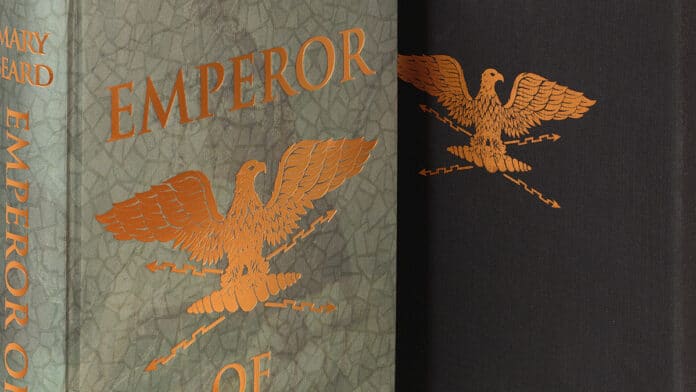
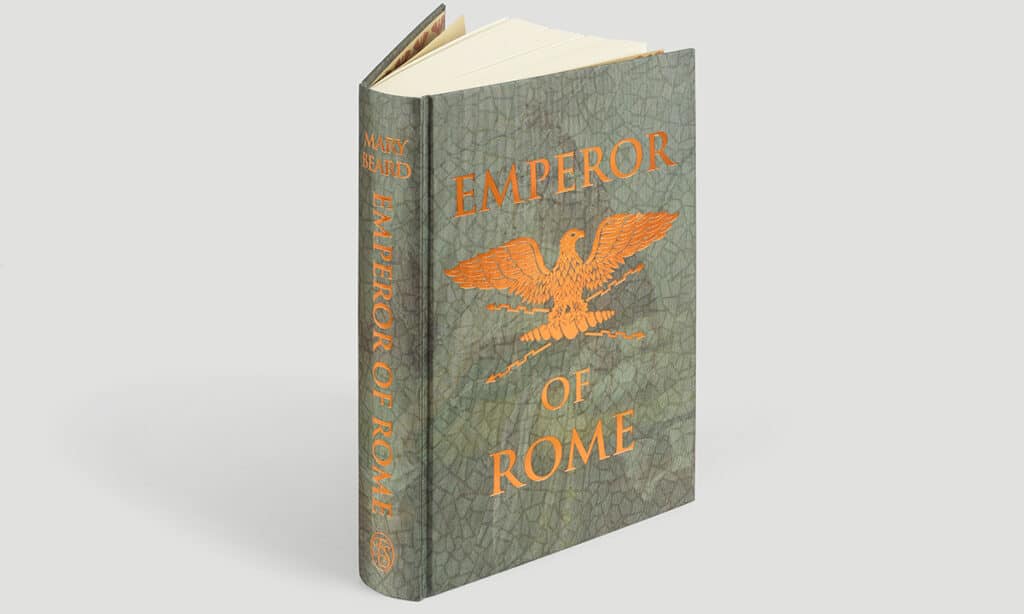
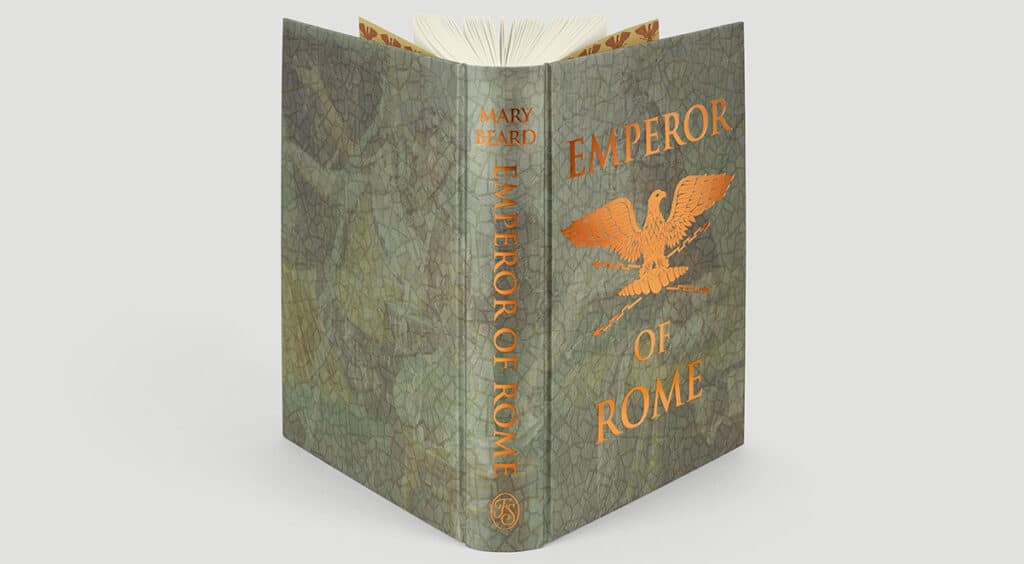
Although the original hardback edition of ‘Emperor of Rome' was well-produced with maps, family trees, illustrations and photographs, Mary Beard's words are lifted off the page even more satisfyingly in this spectacularly-produced edition from the Folio Society. The black card case is embossed with a golden Aquila, or eagle, the standard of a Roman legion, and it appears on the cloth-bound hardcover too. The text is interspersed with 48 full-colour pages that portray images of Roman statuary, mosaics, frescos, coins and paintings. Throughout the book there are many black and white images on the standard pages to enrich the text. If you enjoy Mary Beard's prose, then it has never been better-presented than this. ‘Emperor of Rome' is the ultimate gift for the lover of Ancient History in your life. It is an exciting gallop through three hundred years of history that centres on who the Romans emperors were, what mattered to them, and how they organised their lives.
Publisher: The Folio Society Publication date: October 15th 2024 Buy ‘Emperor of Rome'

