

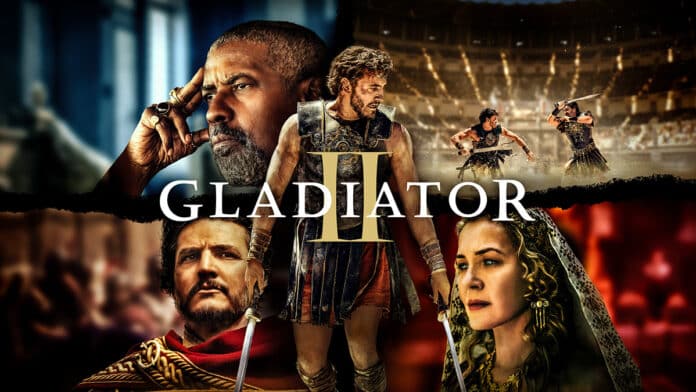

The release of ‘Gladiator' in 2000 provided a memorable moment in cinematic history. I'd just completed a degree in Classics and, despite its historical inaccuracies, ‘Gladiator' won its way to my heart through the sheer brilliance and emotional resonance of its storytelling. After decades in the wilderness, swords and sandals were once again, even if only fleetingly, box office gold.
The Roman epic is always going to be a big and expensive production. A few box office flops, notably 1964's ‘The Fall of the Roman Empire', made filmmakers wary of attempting to connect modern day audiences with a civilisation that has long since come and gone.
‘Gladiator II', therefore, arrived with a difficult challenge of recapturing the magic of the original. But it simultaneously had to provide audiences living a quarter of a century on with a vision of the Roman Empire they could engage with.
The film is connected by a thread to the original, with Russell Crowe's Maximus being revealed as the real father of the illegitimate Lucius, whose mother Lucilla (played by Connie Nielsen in both films) is the daughter of Marcus Aurelius – the last truly great Emperor. The death of Commodus, the evil emperor played by Joaquin Phoenix, leaves a power vacuum. A child with a strong bloodline claim to the throne is therefore in mortal danger. Sent away for his own safety, Lucius grows up in Numidia and takes a local wife. Soon, he forgets his origins as a Roman citizen.
Fate comes calling when a Roman legion, led by General Acacius (Pedro Pascal), conquers Numidia, killing Lucius' wife in the process. The enslaved Lucius is brought back to Rome where, on account of his street fighting skills, he is selected to become a gladiator and is guided by Macrinus, a freedman (Denzel Washington). Swearing vengeance upon Acacius, Lucius builds a following for his exploits in the Coliseum. Meanwhile, disturbed by the incompetence, arrogance and viciousness of dual emperors Caracalla and Geta, Acacius involves himself in a conspiracy to overthrow them and restore power to the Senate, making Rome a Republic once again.
The originality of the story of ‘Gladiator II' is one of its strongest features. You don't have to have seen the original to understand it (though it certainly helps). A few flashbacks and a clever opening animated title sequence subliminally fill you in. It comes close to brilliance with its moral complexity. No character is truly good or evil. There are only shades of grey in ‘Gladiator II'. Most characters owe their lives to another who has betrayed or double crossed somebody else. Everyone has their own agenda. Outside of the obviously mad and bad emperors, ordinary people are either trying to stay alive or make themselves more powerful – recognisably human traits.
There are some standout performances. Connie Nielsen is a study in defiance and dignity as Lucilla. Pedro Pascal is probably the most sympathetic character in the whole film as General Acacius, and his meetings with Lucius form the backbone of the film. Denzel Washington is dependably superb, but he sublimely embodies Macrinus, the former slave with ambitions for power (inspired by the Emperor whose short reign followed that of Caracalla?). Those three provide characters that burn themselves into the memory banks. It must also be noted that Joseph Quinn and Fred Hechinger make for an enjoyable double act as grotesque emperors Geta and Caracalla, though they are such obvious caricatures that they are inevitably cartoonish. Neither bears comparison to Joaquin Phoenix's neurotic, sadistic Commodus, who was chilling thanks to his credibility.
That leaves Paul Mescal as Lucius. He looks the part, and in the fight sequences comes into his own. But there's something about his vocal inflections that often make him sound bored and disconnected from the extraordinary events around him. The biggest handicap of ‘Gladiator II' is that its star doesn't come close to filling the almighty sandals of Russell Crowe. He may well play a Roman general with a New Zealand accent, but he embodies Maximus with such guts, smouldering intensity and burning rage that by God you believe every second of his performance. The same cannot be said of Mescal, who is rather too lacklustre to convince. At no point does he come across as a leader of men.
There are a few sops to please the classicists. At one point Lucius says of the Romans, “They make a desert and call it peace” – one of the historian Tacitus' most famous lines. There is a showdown fight sequence at what is clearly meant to be the Rubicon – the shallow river crossed by Julius Caesar and his army that led to the end of the Republic. But then there's also what appears to be the colossal foot of Constantine the Great – a bit of statuary that wouldn't be carved for another century after the events depicted. Most glaringly, the film relies on the supposition that Rome could be great again and its people free and happy if only the Empire is overthrown and power is restored to the Senate. This is despite the depiction of the Senate in the film as a bunch of weak and ineffectual old men who don't look like they could run a bath, let alone an empire. It also completely ignores the inconvenient decades of bloody civil wars that led to the downfall of the Republic in the first place. Worst of all, the somewhat enigmatic ending perhaps results from the fact that things were about to go from bad to worse after the death of Caracalla. Look up Elagabalus, Emperor only a year after the death of Caracalla, if you don't believe me. Didn't Caracalla at least build some impressive bath houses that attracts visitors in Rome to this day?
Of course, nobody goes to see a Roman epic with the expectation of fidelity to historical accuracy. More problematic for ‘Gladiator II' is that you can find yourself asking questions such as: why didn't Macrinus simply fire two arrows when he had the chance? When you start asking questions like that, you know you're not wholly sold by the events on the screen.
Despite a few misgivings, ‘Gladiator II' looks and sounds spectacular. Put simply, it has enough style and artistry to keep the doubts at the back of the mind. The location filming in Morocco and Malta visually brings to life the early Third Century. Director Ridley Scott's command of action sequences is undiminished. The Roman triremes approaching the walled city at Numidia is once such triumph of visual storytelling at the start of the movie. In 4K UHD, the film looks incredible, and it is a feast for the senses from start to finish. Ancient Rome has never looked so attractive, or so seductively wicked.
Several extra features, running around 10 – 20 minutes each, provide movie fans who like to go behind the scenes with plenty of insights. ‘A Dream that was Rome: the Origins' hears from director Ridley Scott on the origins of the sequel. He divulges details about its long gestation period before he found the story he wanted to tell. ‘What we do in life echoes in eternity' (a famous line from the original that takes on new resonance in the sequel) finds cast members talking about being approached to star in the film, and Ridley Scott outlines why he considered them right for the part. The most impressive featurette is ‘In the Arena: Filmmakers'. It finds production designer Arthur Max in Malta overseeing the recreation of his stunning Coliseum set that had wowed cinemagoers in the original film. ‘To Those about to die, we salute you: combat' is the place to look for more about how the stunts, battle and fight sequences were coordinated. In ‘Building an Empire: Post-Production', editor Claire Simpson and Ridley Scott discuss cutting the film together. It outlines the contribution of CGI in bringing to life the visuals as well as the work of composer Harry Gregson-Williams, who pays homage to Hans Zimmer, the composer of the original score. All of these threads combine in ‘The Making of Gladiator II', which takes unused sequences from the same interviews. Finally, some deleted scenes offer the chance to see dramatic moments that filmmakers have to sacrifice to keep a running time of under two and a half hours.
Overall, ‘Gladiator II' has enough originality and moral complexity about its story to recommend it. There are some superb performances and it is visually thrilling. More negatively, it isn't as compelling as the original story that it follows on from, and nor does it ever quite emerge from its shadow. Despite that, it keeps you entertained if you don't think too hard about the plot strands that don't satisfy.
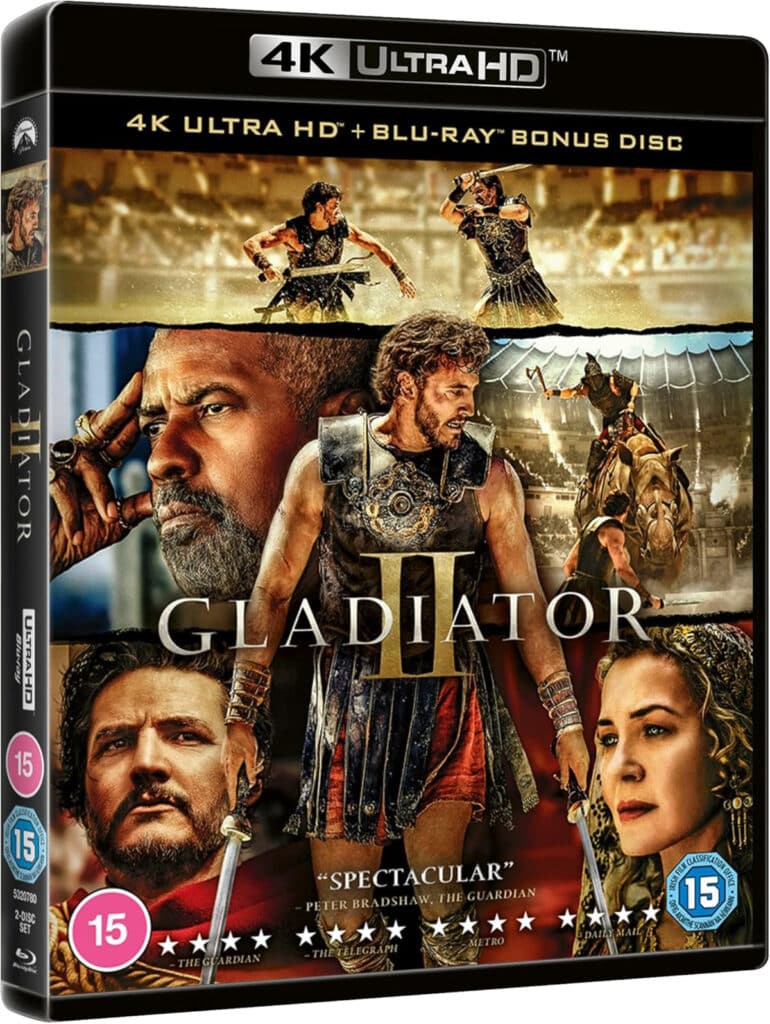
Cast: Paul Mescal, Denzel Washington, Pedro Pascal, Connie Nielsen, Joseph Quinn, Fred Hechinger, Derek Jacobi, Tim McInnerny Writers: David Franzoni, Peter Craig, David Scarpa Director: Ridley Scott Running time: 148 mins Released by: Paramount Home Entertainment Release date: 4th March 2025 Buy ‘Gladiator II'

