


They say you end up in either ‘The Iliad' or ‘The Odyssey' camp, favouring one of Homer's epic Ancient Greek poems over the other. By way of opening confession, as a Classics student I was always firmly in ‘The Odyssey' camp. My younger mind was captured by the interfering gods, the dizzying array of mythical creatures and the audacious non-linear storytelling of the second part of the tale.
Fast-forward thirty years, and Emily Wilson's new translation of ‘The Iliad' (the first part, with her companion tome ‘The Odyssey' earmarked for publication as part of The Folio Society's Summer 2026 Collection) has given me by far the most captivating experience I've ever had with ‘The Iliad'. True, there's something a touch austere about the Martin Hammond translation I studied (chosen because he had translated other primary sources on the reading list). But most incongruously, his version is in prose! I recall long nights on instant coffee, propping myself up with broken biscuits, shivering by the single bar fire as I struggled heavy-eyed through Book Two. Back then it was such a dreary and interminable list of ships…
What a difference to experience ‘The Iliad' as Homer's audience would have done – as a poem! True, there are other translations in verse, but a few in recent decades have been decidedly uninspired. Emily Wilson's superb translation offers readers an immediately accessible version of a story that is around three thousand years old. (Another act of throat-clearing is to admit I can't read a word of Ancient Greek – I'm judging it purely on its merits in English verse.)
That's not to say her ‘Iliad' isn't a superb and impressive work of scholarship – it's certainly that. But Wilson's ‘The Iliad' uses accessible language for a general readership. This is important as ‘The Iliad' is oral poetry – it is meant to be read aloud and listened to, and ideally enjoyed as a performance (optimally, as a shared experience around a campfire). British readers will appreciate that the verses are set out in iambic pentameter – a common rhythm familiar from the plays of Shakespeare. This lends the words a musical flow as well as a sense of drama and forward motion. In her translator's note, Wilson sets out the reasoning behind her choice, and it proves to be inspired.
The end result is that Wilson's ‘The Iliad' trips delightfully off the tongue. It vividly captures the spirit and the epic, bombastic qualities of the poem. Another commendable choice that she makes is to avoid using too many of the stock phrases and descriptors familiar in epic poetry. Whilst a Homeric hallmark, there's only so many times you can read ‘rosy-fingered dawn' (found ad nauseam in more literal translations) without it becoming wearying.
‘The Iliad' has stood the test of time as one of the foundational texts of Western literature. The characters are masterfully drawn, and their personalities and emotional states are as integral to the storytelling as the plot. The poem recounts the final weeks of the Trojan War, in which the Achaeans (Greeks) are locked in conflict with the Trojans. Advancing as far as their home city of Troy (modern day Turkey), the Achaeans seemingly have the advantage. But their greatest warrior, Achilles, quarrels with their leader, King Agamemnon, and refuses to fight. Without him, the Achaean troops suffer in battle, and the Trojans gain the upper hand. Hoping to inspire the troops, Achilles' closest friend Patroclus dons Achilles' armour and rides into the fray. Believing Achilles to have returned to the conflict, Patroclus is hunted and killed by Hector, the Trojan's greatest warrior. When news of his friend's death reaches him, Achilles explodes into a fit of grief and rage. He swears bitter vengeance and will stop at nothing until he comes face to face with Hector, the killer of Patroclus.
Although telling the story of a conflict between two nations, ‘The Iliad' enthrals readers to this day because the clash of troops forms the background to lives of the main characters, which we gradually know in intimate detail. The catalyst for the war is a squabble over the marriage of Helen, and everything builds towards the climactic showdown between the great warriors of opposing sides, Achilles and Hector. Supporting characters, particularly the clever and cunning survivor Odysseus, have their moments in the sun. The night raid on the Trojans is surely one of the most memorable passages.
In her introduction, Wilson says that ‘The Iliad' always moves her to tears. Sentimentality increases with age, and on this occasion, I found myself welling up for the first time on reading this story. The appeal of elderly King Priam, leader of the Trojans, to Achilles' better nature, is both startling and moving. Here are two men on opposing sides, both suffering the pain of grief from a loss caused by the other, coming to a reasonable, rational truce. In a world riven with conflict, now and throughout human history, it's hard not to weep at these scenes, hopeful as they may be.
‘The Iliad' can be shocking too. Wilson's translation is immensely powerful when Achilles' bloodlust for revenge consumes him into dishonouring a vanquished enemy. In these moments, Wilson's verse is as visceral as Shakespeare in describing murder or war. In the background, the gods huff and puff, but generally don't interfere too directly in the affairs of humans. Their scenes are always enormous fun!
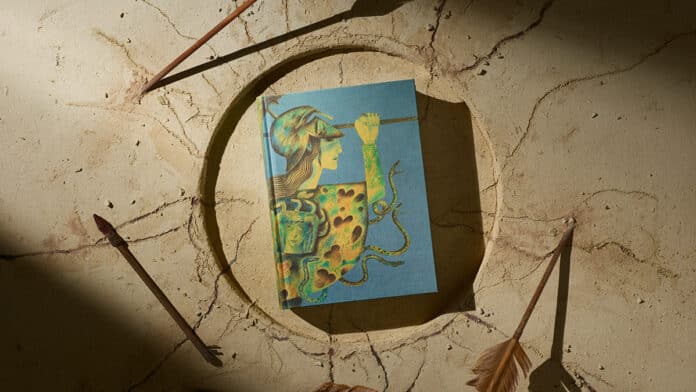
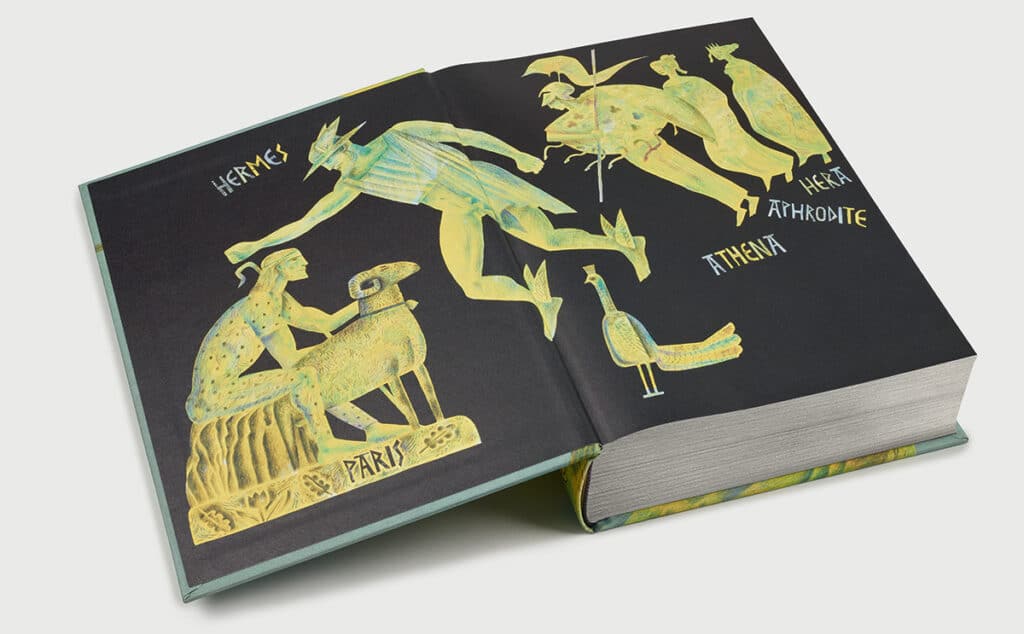
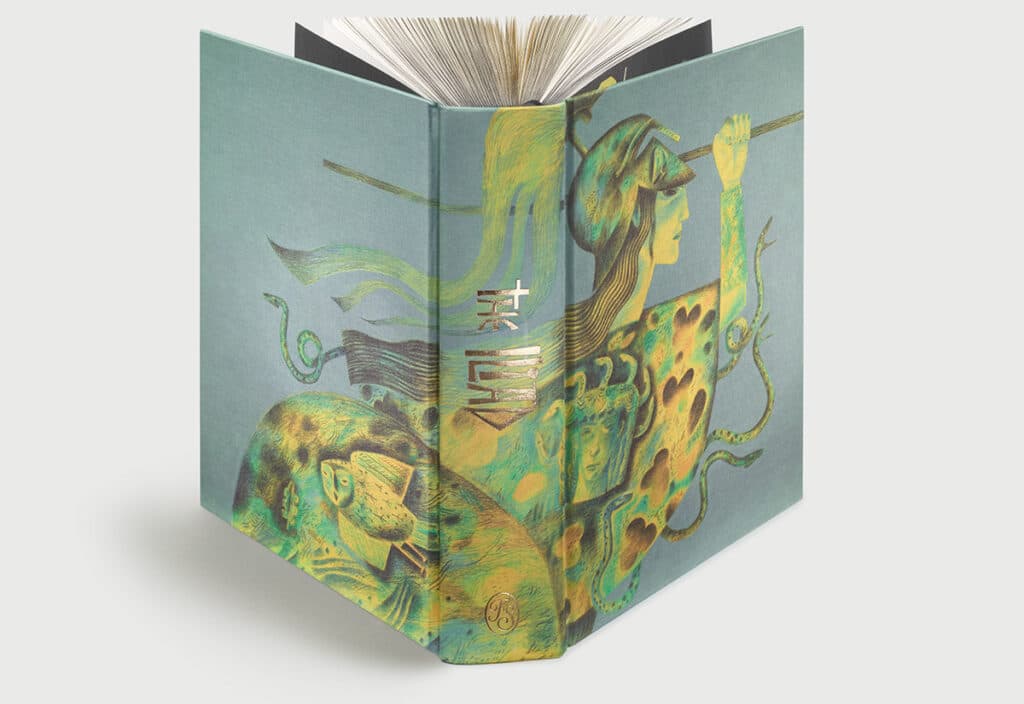
A large part of the appeal of this book is that it is startlingly beautiful. Not only is Wilson's verse translation magisterial, but the design work is exquisite. The immediacy of the text is heightened by Clive Hicks-Jenkins' illustrations that pick out key moments from the poem. Adopting the style of Ancient Greek pottery, familiar from museums and book covers, the figures are depicted in two-dimensions against a black background, with their names providing clear identification. A modern twist on art that immediately recalls ancient history is entirely fitting.
There are many finishing touches that are a credit to the attention to detail and high production values that go into Folio Society titles. The edges are gilded in silver and the section headings and verse numbers are printed in red so as not to distract the eye when reading. You'll also find maps, genealogies of the Houses of Atreus, Troy and the gods help you to understand where the action is taking place and how the characters relate to one another. This is helpful even for readers who know the story intimately.
The only downside to this magnificent edition of ‘The Iliad' is that, at 678 pages and with a cloth-bound hardback, it is heavy in the hand, rendering it a tricky choice for nighttime readers. I adapted my habits by reading downstairs and transferring to the office seat where I could lay it out on the desk if my hands became tired from holding the weight. This in no way detracted from the pleasure of reading a fantastic new translation that so effectively brings to life one of the greatest stories ever told. ‘The Iliad' has been in my life for three decades, and it's Emily Wilson's translation I will return to the next time the great conflict between Achilles and Hector calls to me.
Publisher: The Folio Society Publication date: March 2026 Buy ‘The Iliad'

