

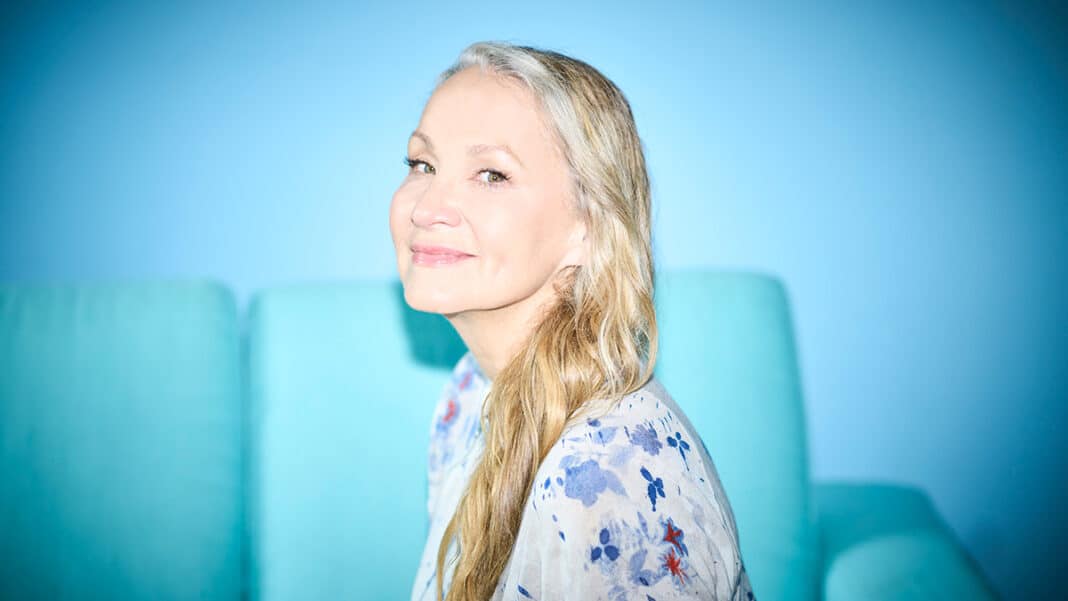

Singer-songwriter Joan Osborne rose to prominence in the 90s with her global smash ‘One of Us', a song that still gets regular airplay on radio to this day.
The parent album ‘Relish' established Osborne as one of the most exciting emerging stars of the decade and nearly 30 years on, Osborne is still touring the world and regularly releasing new music as an independent artist. Next month, Osborne will return to the UK for her first live show in six years at London's Union Chapel.
I caught up with Osborne to discuss her forthcoming return to London, talk about the enduring legacy of ‘Relish', and to find out how she's managed to maintain a successful career in a music industry that is forever changing…
Your show in July will be your first show here in six years. Are you excited about coming back?
Oh, absolutely. In particular that venue, the Union Chapel, it's just so magnificent. It's one of those really special rooms that pulls the songs out of you. It's almost effortless to sing in a space like that so of course I'm very happy to be coming back there. Six years is too long. The pandemic really curtailed a lot of my touring and I guess that's the only reason it's taken me that long. I'm definitely looking forward to coming back. I was in the UK in 2018, just to bring my daughter and show her around because she's a bit of an Anglophile. We did just take a pleasure trip but I haven't done a gig there, as you say, in six years so I am very excited to be coming back.
A lot of artists I speak to tell me that their UK fans are different from their fans in other parts of the world. How do you find them?
That's an interesting question. I think (with) my American fans, because I tour mostly in the US, there's less this sense of urgency of like, ‘oh my gosh, we have to go see her, this may be our only chance'. Whereas in the UK people come from Istanbul and Spain and other places if I'm playing a show in London, because they feel like it's their only chance to see me. The British fans are very appreciative in the way that you're appreciative of something that's rare. They don't get a chance to see me very often so I think the appreciation is deeper in that way.
UK fans have a reputation for liking deep cuts from artists, not just the hits. Has that been your experience?
Absolutely. In particular from the ‘Relish' album, there's so many songs that we cycled out of the rotation after a while. We've been bringing some of them back. A song like ‘Right Hand Man', we've worked up a new arrangement for and people kind of go nuts when they hear that. There's a song called ‘Lumina' on that record that we didn't do for many, many years so I think I would consider that a deep cut. We're planning on dipping into some of those and hopefully you're correct about the British fans liking the deeper cuts.
As you've mentioned ‘Relish', I can't help but notice it's the 30th anniversary of the album next year…
It is! That's right.
I was relistening to the 20th anniversary edition of the album on Apple Music ahead of this interview, and it brought back all kinds of memories. That time must have been a whirlwind for you…
Yeah, it absolutely was a whirlwind. Looking back on it, I think the one feeling that I associate the most with it is just gratitude for having had that kind of experience where so many people were listening to that record. Many of them probably came to it because of the hit pop single (‘One of Us') but there was a lot of depth to the record. We put so much time and care into making it, that people who listened more deeply were really rewarded and really got attached to that music, and it really meant something to them. As an artist, that's what you want in your life and your work is to create something that has meaning for people. I'm incredibly grateful for that time of my life.
As a person it was a little uncomfortable at times being that visible. You have a lot of positive energy focused towards you but you also can have certain negative energy focus towards you if you're very visible. For example, there were religious groups in the States that took exception to the song ‘One of Us' and thought that it was blasphemous. They picketed the concerts and I got death threats. There was a sort of an underside to that popularity but I certainly didn't let that stop me playing shows and I just tried to brush that stuff aside and get on with the work of playing concerts. Live performance was my first love and that's what I always wanted to do so. That was an exciting time to be able to play for these really big, big crowds. We opened for Bon Jovi at Milton Keynes playing for 80,000 people two nights in a row and played the Olympics in Atlanta for 100,000 people, these really, really big crowds so there was a lot of excitement around that time.
It's interesting what you say about the ‘Relish' album because ‘One of Us' is really not typical of the record at all. As you say it was the obvious pop single, and it served its purpose, but there is so much more depth on that record. Throughout your career you've drawn on so many different genres of music, and on your latest record, ‘Nobody Owns You', it's a bit more soulful and a little bit more rootsy with some Country and Americana in there. Am I right in thinking you aprpeciate music in all of its forms?
Well, I think most musicians are like that. The genres and these categories that music gets put into, there's certain value in it (but) I think a lot of the value is for people who are trying to buy and sell the music so that they can categorize it and they can put it in the stores in a certain way. Or at least that was the case back when music was still sold in stores and people actually bought it (laughs). I think musicians, in general, don't necessarily see these hard and fast categories. I've always listened very, very widely. I was cleaning out a closet the other day and I found some mixtapes that I made back in the late 1980s and there was everything from Ann Peebles and gospel choirs to Iggy Pop and Puccini. I was listening very widely back then and I just love music so deeply that I never felt like I needed to just limit myself to one particular avenue or one narrower genre. I don't fault people who do that (who) devote their lives to being a blues artist or a bluegrass artist or something, there's people who I massively respect who do that, but for me I just never felt like that was what I needed to do. I felt like my calling was more about drawing from these different influences and creating something that was unique to me out of that, and if it leaned a particular way towards Country music, for example, or towards blues music or whatever, then that's fine. I wanted to make things that only I could make.
You mentioned about the way music consumption has changed. I'm still a big advocate of buying music…
Bless you (laughs)
I will be a CD, cassette and vinyl person until I die. Throughout your career, you've seen that shift. In the 90s it was very much how many CDs can you shift in a week? Now it's all about streaming and playlists, and it's almost like genre isn't quite as important as it used to be. I really think that music consumers don't care about genre, they just listen to what they consider to be great songs. Is that freeing for you as an artist to see the industry move that way?
Well it's very interesting, actually as a parent, because I have a daughter who is a teenager now and she will come up with these songs that she heard on an advertisement or that she saw 10 seconds of on a TikTok video, or that she heard in a movie or on a TV show. It's stuff like the Isley Brothers' version of ‘Summer Breeze' – how does an 18-year-old find that these days? I feel like that is very interesting to see this sort of element of randomness, whereas when I was coming up you had this genre of music that became part of your identity. If you liked punk music, you were a punk, and that was part of who you were. If you love blues music, you were a blues fan and that was part of your identity. I think people listening nowadays don't have that sort of association of ‘I'm this kind of person, because I listen to this kind of music'. They are listening much more broadly and they're finding the music in much more random ways.
Streaming is the main way for artists to be heard now but we now that there are issues around the royalties, and that it's hard to make a living from that model. How are you finding releasing music as an independent artist in the modern era?
I mean, I can't lie and say that it's not more difficult. There was this whole stream of income that you used to be able to rely on to help pay your bills. People would buy CDs or vinyl or whatever, and that's much, much less the case now. It is harder. It shifts the focus to live performance, which for me is fine because, as I said, that is what I always love to do so the fact that I'm more forced to do it is fine with me (laughs). I think there are other artists who are less oriented towards live performance, who are sadly unable to make a living and have to get day jobs so I think for music in general, it's not as good. I think if you're a listener it's a good time because you do have access to all this stuff that's essentially free once you subscribe to the platform. But if you're making the music and you need to try to be paid for the work that you do, it is more difficult. I'm fairly well established and it's not as great for me, but I'm getting by, but I feel bad for people who are coming up now and trying to make a living in music because I think it's much more difficult than it used to be.
I see so many artists going viral with millions of streams on TikTok but they can't sell records or shift tickets to live shows. How is that a sustainable model for artists moving forward?
Yeah. I feel like maybe the old school way is still the way, where you build your audience from playing live shows and you get word of mouth from playing live shows. I was playing in clubs in New York City back in the late 80s and went from having one gig to a couple of years after that, playing five or six nights a week in New York, and then expanding out to Philadelphia, and Boston and DC, and upstate New York, and New Jersey, and all of that. Just building it one step at a time. Thankfully, people wanted to come and see us and we had enough support from fans spreading word of mouth, or from journalists talking about the shows that people came to see us and I was able to build something, really from the ground up in that way. I feel like maybe that's an alternate model that has more staying power than what you're referring to, which is you have a 15-second clip that goes viral and yet it's not something you can sustain a career on.
As a passionate music fan I'm worried about where music is going to be in 30 or 40 years. We have all these one-hit artists on TikTok now that can't sell albums or live shows, that won't have long careers. Surely it has to swing back around at some point to how it was?
That's an interesting question. I'm not sure. I don't know what the world is going to look like in 30-40 years. There's a lot of different variables in play (laughs) not just within the music world, but just in the world in general so who knows. We might all be in caves scratching out and trying to eat roots or something (laughs) I have no idea. The thought of recorded music will be the last thing on anyone's mind. We'll be singing around campfires.
You've managed to sustain a career over decades. You're still releasing music and you're still touring. What's your secret? How have you manage to succeed where so many artists have failed?
I try very hard to keep it interesting for myself. We talked about the ‘Relish' album because that's the one that most people know me by, but I've put out records every couple of years since then. I've always tried to keep myself interested and keep myself stretching and growing as an artist and as a songwriter in particular. (I'm) trying to make it fulfilling for me and hoping that it will therefore be fulfilling and interesting to an audience. I am lucky that I did build my fan base from the ground up via live performance so people know me for more than just some little tiny clip, and they know what they're gonna get if they come to see one of our shows. If they buy a new record, they know that it's something that I'm really engaged with, and that I put my heart and soul into. If you can keep it interesting for yourself, then other people are bound to be attracted to that, and I did come up in a time where you could build a fairly massive audience off of one record as well. I'm sure I'm still riding the success of that album as well. I think for me, it's a combination of those two things; having had this from the ground up, organically built fan base, and then adding that popularity of the one record on top of it, and touring that all around the world and the opportunities that came from that. I'm very, very fortunate in that way. At the heart of it, it has to be about me feeling engaged with it. I can't just toss off something and expect people to be interested in that if I'm not interested in it myself.
We touched on it briefly earlier but let's talk about your latest record ‘Nobody Owns You'. It came out last year and I imagine we'll be hearing selections from it at your London show. What was the concept for that record when you set about writing and recording it?
That record came out of a very tumultuous time for me personally. I was ending a 15-year romantic relationship, my daughter was getting ready to leave home and go to college, my mother's dementia was, and is, increasing and becoming really impossible to ignore and she's sort of disappearing in front of my eyes, and I also turned 60 that year. It just was a lot of things going on that motivated me to take stock of my life and think about the fact that we're all mortal and that this isn't going to go on forever ,and what did I want to see the rest of my life look like. There are songs which are very personal. The title track ‘Nobody Owns You', I wrote that for my daughter because I could see that she was falling under the spell of people who were trying to manipulate her. She was seeking approval from people who really didn't have her best interests at heart so that's where that phrase ‘nobody owns you', and where that song, comes from, just to try to help her see that she's really complete unto herself, and she doesn't need the approval or the acceptance of these other people who are trying to manipulate her. I see that not just in my own daughter, but I see it in our culture in general, that despite how far we've come with encouraging our young women and our girls, and and lifting them up, they still seem to feel like everyone has to like them, and no one can be mad at them, and they have to look a certain way, and they can't make any mistakes. I think it's a recipe for them being manipulated by people so I was trying to put something out there that was about that.
‘So Many Airports' is looking back on this almost trance like state that you get into when you're on the road. You wake up some days and you don't really know where you are, and you don't know what town you're in. It takes you a minute to figure out ‘oh, yeah, I'm in Tulsa today and last night, I was in Wichita'. It becomes this unending parade of the different backstages and the hotels and the highways, and the airports and all of that. It's a meditation on that. The rest of the songs are from that very tumultuous, and I guess soul searching, period of time that I was going through.
You mentioned then about kind of the disorientation of travel. Have you ever made that classic artist mistake of walking out on stage and naming the wrong town or city?
I try to avoid that by not saying the name of the town. I might say it in London because it's pretty hard to mistake London for anywhere else.
‘Nobody Owns You' came out last year and you're touring this year. You're known for being very prolific so are you thinking about the next record already?
Absolutely. Well, as you pointed out, the ‘Relish' album is going to be celebrating its 30th anniversary next year so myself and my touring band are going to go into the studio and do something. I think we're going to call it ‘Relish Reimagined' where we're going to do different arrangements of these tunes from the record. As we've played the songs live over the years, the arrangements have changed. We've given them different flavors and the fans always seem to really respond to those in concert so I thought why not record these and put them out as a companion piece to the the original record for the 30th anniversary? So we're going to do that. We've also been working a little bit on a Lou Reed covers record and I've been writing original songs as well. I'm not sure what will happen after ‘Relish Reimagined' and which one of those will be first. There's definitely not enough time for me to make all the records that I would love to make in my life (laughs). While I still have voice to do it, I'm trying to stay engaged in that process and get in the studio as often as I can.
‘Relish Reimagined' will be really interesting because as you say you've toured these songs for nearly 30 years at this point. Do any of the songs from that record mean something different to you now than when you first recorded them?
Oh, absolutely. The song ‘Crazy Baby' in particular has become something that the fans have really taken to their hearts. I've received so many amazing letters and emails and talked to fans after the shows, and heard people talk about that song as being really special and meaningful to them. We're going to try to honour that in the way that we re-record it. A song like ‘Right Hand Man', that is really fun to play live and I've started playing acoustic guitar on it. I'm not the greatest player but I get down into the rhythm of the acoustic guitar and try to relive that moment of walking down the street, and you've just left the house of somebody that you've had a fling with, and you can tell that everyone in the street sort of knows what you've been up to, because of the way you're smashing down the sidewalk. Just celebrating that moment, and being very sex positive, and the opposite of slut shaming but being very celebratory of that moment. That's always really fun.
The songs, I think certain of them have changed in meaning for me personally. The hit song ‘One of Us', it's such an interesting song. People ask me, ‘are you tired of singing it?' and I have to say I don't get tired of singing it because there's so many different aspects to it. It's like holding up a jewel to the light, and you can see different facets of it as you perform it over the years. I think it's open ended because it's asking you what you think, as opposed to telling you what you're supposed to believe. That's why I think the song has changed in meaning for me over the years, and why I think people still engage with it, and still find themselves able to connect to it, whereas another hit from the 1990s they don't think about that anymore. That song, ‘One of Us', stays with people and they do still connect with it. People who've never heard us before, will be brought to a show by someone and (they'll say) ‘I've never heard this song before but I love it'. It still has some power and some meaning to it.
I always find ‘One of Us' to be such an interesting song. I was 11 or 12 maybe when it came out and I never really thought about religion until that point. I remember this song and in some ways it almost demystified the idea of God for me, because it made it relatable in a way that nobody else had managed to before…
There's the Buddhist principle that God is within us and is everywhere so you can also have that kind of reading of the song. God is not some, all seeing all knowing heavenly creature but God is in us and all around us, and every moment can be holy, and every moment can be full of God, if you're able to see it in that way, and live your life that way. It'd be great to be able to live that way. I feel like I reached that understanding, only in moments and only in certain times, but that's something to strive for, and that's something that the song reminds me about every time I perform it.
Joan Osborne will perform at Union Chapel in London on Tuesday 2nd July 2024. Tickets are available now at https://unionchapel.org.uk/whats-on/joan-osborne. Her latest album ‘Nobody Owns You' is out now.

