

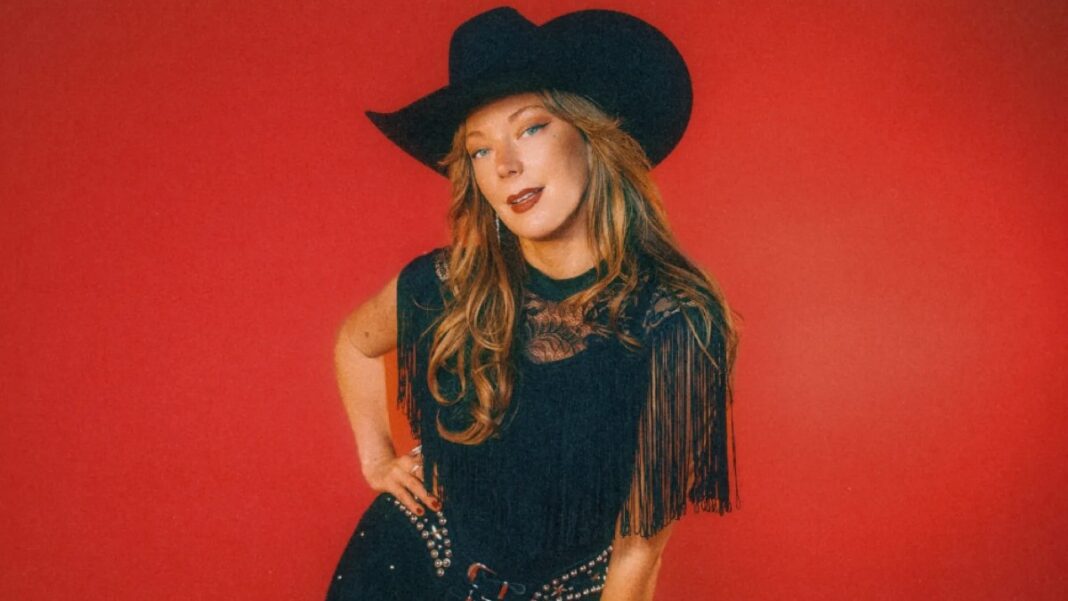

Few artists in modern country have experienced a breakout quite as dynamic as Kaitlin Butts since the release of her 2024 album ‘Roadrunner!.' What began as a bold, theatrical concept record, drawing inspiration from classic musical theatre and her Oklahoma roots, has quickly snowballed into a career-defining moment. The album didn’t just earn critical acclaim; it repositioned Butts as one of the most inventive and unpredictable voices in the genre, blending traditional country storytelling with a flair for drama and character that set her apart from her peers.
In the months that followed, everything accelerated. Viral success came in the form of ‘You Ain’t Gotta Die (To Be Dead To Me)', a razor-sharp anthem that racked up millions of views online, while high-profile moments, like her cameo in Ella Langley’s ‘Choosin’ Texas' video introduced her to an even wider audience. Add in major touring opportunities alongside Lainey Wilson, international festival slots and a growing reputation for electrifying live shows, and it’s clear Butts has moved from cult favourite to genuine force in country music. Now, as she brings her ‘European Cowgirl Experience' to the UK (kicking off in Leeds tonight) she arrives not as an emerging act, but as an artist fully stepping into her moment. We caught up with her to talk all about it.
Welcome back to the UK! It feels like every time you come over, your profile has grown again. How does it feel to be back, and how have the travel and jet lag treated you this time around?
I’m so happy to be here, honestly, I’ve been really excited for these shows. The travel was totally fine, and weirdly I don’t really get jet lag when I come over here… it usually hits me when I get home instead. I feel like I’ve hacked the system a little bit there! And I’m choosing to believe what Taylor Swift says, that jet lag is a choice, so I’m just going to keep telling myself I’m fine and roll with it. (laughing)
You’ve now played the UK multiple times: festivals, headline shows, and now venues like the Royal Albert Hall. Have you noticed a difference between UK and US crowds when it comes to country music?
Absolutely, there’s a really noticeable difference, and it’s something I always look forward to when I come over here. I think a big part of it is that you don’t get country music in the UK as often as we do in the States, so there’s this real sense of excitement and appreciation from the crowd. Not that audiences back home aren’t appreciative, of course they are, but it’s just more accessible there, whereas here it feels like people are really making the most of the moment when it comes to town.
What stands out to me the most is how early people show up and how engaged they are from the very beginning. At festivals in the US, if you’ve got an early slot, like noon, you might be playing to a smaller crowd that’s still filtering in. But over here, people are already there, packed in, ready to go as soon as the gates open. I’ve seen that at festivals and even at my own shows across Europe this week: I was genuinely thinking, “Who’s going to come out to this? The sun’s still up, it’s early,” but people still turn up in full force. That kind of energy changes everything as a performer.
There’s also just this feeling that people are really listening. They’re taking it in, they’re connecting with the songs, and they’re there because they truly love the music. It creates such a special atmosphere, one that feels really warm and intentional, and it makes playing over here feel completely unique compared to anywhere else.
You’re about to play the Royal Albert Hall which is one of those iconic venues artists dream about. Where does that sit for you alongside places like Red Rocks or Madison Square Garden?
That’s such an interesting one, because Red Rocks and Madison Square Garden have always been these big, long-term goals for me, they feel like a stretch, but something you could maybe reach if everything lines up right. The Royal Albert Hall, though, almost feels different… like it wasn’t even something I allowed myself to dream about because it felt too far away.
So getting to play there is actually even cooler in a weird way, because it wasn’t on my “attainable” list: it just kind of happened. And those moments, where you’re like, “I didn’t even think this was possible,” are the ones that hit the hardest. I’m really excited to be part of it.
Since we last spoke around the release of Roadrunner!, your career has accelerated massively with record deals, major tours and viral success. Can you even summarise what the last couple of years have been like?
It’s honestly been a whirlwind, and I don’t even know if I’ve properly processed all of it yet. (laughing) If I try to sum it up, I think the biggest thing is just how much attention everything has been getting: and I’ll be real, I really like it. (laughing) It’s something you work towards for so long, so when it finally starts happening, it’s both exciting and a little overwhelming at the same time.
Since our last conversation, there have been some really big, defining moments. Signing my record deal with Republic was huge, that’s one of those things you dream about for years, and then suddenly it’s real. Touring with Lainey Wilson across Australia, Canada and the States was another massive step, because those shows put me in front of so many new people and really helped grow everything. And then on top of that, there have just been countless opportunities, things that, at the time, you don’t even realise how important they are, but when you look back, you see how much they’ve all added up.
The truth is, it’s been a constant flow of movement: new audiences, new experiences, new doors opening and it’s almost been too much to sit down and fully take in. I feel like I’ve just been in it, going from one thing to the next, trying to keep up with everything that’s happening while also thinking about what’s coming next. Because at the same time, there’s a whole new wave of opportunities ahead this year, and a vision of where I want to go next. So it’s this mix of gratitude, excitement and just trying to stay grounded while everything around me is changing really quickly.
“You Ain’t Gotta Die (To Be Dead To Me)” became a viral moment for you. How did that feel and has it changed the way you approach songwriting or your audience?
It’s been a really cool experience, because if I’m being honest, ever since I was a little girl I had this idea in my head that I wanted to have a song go viral one day. (laughing) So to actually have that happen feels a little surreal, it’s like one of those things you dream about without really knowing what it looks like when it becomes real.
But the interesting part is that when we wrote that song, we weren’t trying to make something for TikTok or trying to chase a moment like that at all. It was actually the opposite. We were just focused on writing something honest and something that I knew would hit live, that was always my instinct with it. I thought the hook would land in a room, that it would be one of those songs people latch onto in a show, but I had no idea it would translate the way it did online. And it didn’t even happen straight away, it was almost a year later that it really started to take off, which just proves you can’t predict any of it.
In terms of songwriting, I think once you have a viral moment, there can be a temptation, maybe for some artists, to start thinking, “Okay, how do I recreate that?” or to tailor songs toward a certain audience or platform. But I’ve tried really hard not to do that, because that wasn’t how that song came about in the first place. For me, it’s still about writing the best songs I can and trusting that if something connects, it connects for the right reasons.
What it has done is broaden my audience in a really noticeable way. I don’t think it’s necessarily skewed younger, it’s more that it’s expanded everything. When I look out at my crowd now, I see such a wide range of people. There are younger fans, sure, but there are also older couples, groups of women, guys who’ve been coming to country shows for years, it’s all mixed together. There isn’t one “type” of person that comes to my shows, and I think that’s really special.
That kind of diversity in an audience is something I really value, because it feels like people are connecting to the music in different ways, for different reasons. It’s not tied to one demographic or one moment: it’s something that’s growing and evolving, and that’s what makes it feel like it could last.
From an outside perspective, it feels like the Kaitlin Butts of 2026 has evolved a great deal over the last two years: both the character on stage and the person behind it. Do you feel that change yourself?
I think that’s an interesting way of putting it, because in a lot of ways I actually feel very much the same at my core. The version of me that people see on stage, that bigger, more theatrical, more expressive side, that’s always been there. It’s not something I’ve created recently, it’s just a part of my personality that gets to come out in a much louder, more exaggerated way when I’m performing. I still feel like that theatre kid I was growing up, who loved putting on a show and stepping into a character, and I think that’s always going to be a part of how I present myself as an artist.
If anything, the biggest shift over the last couple of years has been more internal than external. I’ve become a lot more aware of what makes me me, and a lot more protective of that. When your career starts to grow and more opportunities come your way, there are naturally more voices, more opinions and more people who want to have input into what you’re doing. And while that can be a really positive thing, it can also make it easy to lose sight of your own instincts if you’re not careful.
So for me, the evolution has really been about learning how to hold onto those instincts, protecting the parts of myself that are authentic and making sure I’m not letting anyone else take control of that. It’s about remembering where I came from, what I love about music, and why I started doing this in the first place. I feel like I’ve grown in confidence in that sense, not necessarily changing who I am, but becoming more intentional about staying true to it.
You had a standout cameo in Ella Langley’s “Choosin’ Texas” video. How did that come about, and what was that experience like?
That was honestly one of the coolest and most unexpected things. She literally FaceTimed me from the gym and just said, “Do you want to be in my music video?” and I was like, “Of course!” I didn’t even ask any questions, I just said yes straight away. (laughing) When a friend asks you to be part of something like that, you don’t really think twice about it. I assumed I’d just be in the background somewhere, maybe as an extra or just hanging around on set, and I was totally fine with that. I was like, “I’ll do whatever you need, I’ll bring you water all day if that helps!” (laughing)
But then I got there and realised I actually had a proper role in it, like a real acting part, which made it even more fun. Getting to step into that world and play a character was such a cool creative experience, especially because I love that kind of storytelling element anyway. It felt a bit like an extension of what I already do with my own visuals, but just in someone else’s universe.
And on a personal level, it meant a lot because I love her and she’s been so supportive of me. She’s one of those artists who genuinely lifts other people up, and she actually played a huge part in helping me get my record deal. If she and Avery Anna hadn’t posted on TikTok and shown that kind of belief in me, things might have looked very different. So to be asked to be part of her video, and then to have it turn into something bigger than I expected, was really special. It felt like a full-circle moment in a lot of ways.
You’ve also stepped behind the camera, co-directing and writing treatments: like for Flatland Cavalry. How important is that visual storytelling side for you?
Honestly, it didn’t feel completely new to me because I’ve always been really hands-on with the visual side of my own projects. For all of my music videos, I’m usually writing the storyline, mapping out the shots, thinking about the pacing: I’m very involved in that whole process. So stepping into that role for Flatland felt like a natural extension of something I already love doing, just applied to someone else’s music instead of my own.
With that video, I really wanted to create something that felt cinematic and intentional, something that matched the emotion and tone of the song, but also told a clear story. I worked with a director I collaborate with a lot, Chris Beyrooty, and I basically said, “Let me build out this concept and I think we can make something really cool here.” I take a lot of pride in my own videos, they’re very story-driven, almost like little films, and I wanted to bring that same level of detail and creativity to this project.
It definitely uses a different part of your brain compared to songwriting, but I love that. For me, the creative process isn’t just about writing the song, it’s everything that comes after that too. Once the music is there, I start thinking about how it looks, how it feels, how you present it to people. The visual world around a song is just as important to me as the song itself. So getting to step into that role and help shape someone else’s vision, while still bringing my own creative instincts into it, was really exciting. It’s something I’d love to keep doing more of, because it just scratches a completely different creative itch for me.
Humour is such a big part of what you do on stage. What makes you laugh, and where does that side of your personality come from?
I love that people pick up on that, because humour is such a big part of who I am, both on and off stage. I consume a lot of comedy, I watch a ton of stand-up, and I really study it in a way, because I think there’s so much you can learn from how comedians deliver things, how they pace a joke, how they build a story. There’s a comedian called Jordan Jensen who I’m obsessed with right now: I’ve probably watched her Netflix special at least a dozen times, maybe more. (laughing) It’s almost like a comfort thing for me, because I know it’s going to make me laugh every single time, and I love that kind of consistency in comedy.
I also love shows like The Marvelous Mrs. Maisel, because it’s not just funny, it’s smart and it makes you think about how humour works. Every time I watch it, I feel like it sharpens my own instincts a little bit, like it gets my brain working in a different way. And then there’s just the day-to-day side of it, the people I’m around all the time. My band are hilarious, and when you’re on the road together as much as we are, you kind of have to be. You’re constantly finding ways to entertain each other, to stay upbeat, to make light of things.
For me, humour is also a way of coping. This job can be intense, it can be exhausting, and there are always ups and downs. It would be really easy to take everything super seriously all the time, but I just don’t enjoy living like that, I get bored, honestly. I’d much rather find a way to laugh through the chaos, to turn even the worst situations into something funny. I think that’s why it comes across so naturally on stage, because it’s not something I switch on: it’s just how I process the world. And at the end of the day, it’s so much more fun to be a little bit silly than it is to be serious all the time.
Catch Kaitlin Butts out on tour this week and at The Highways festival at the Royal Albert Hall this weekend. Tickets available right here.

