

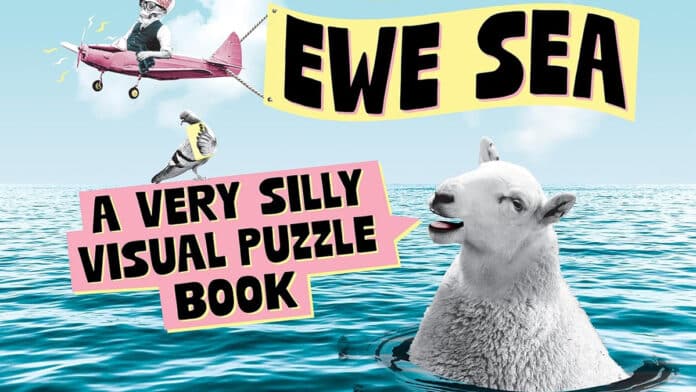

The back cover blurb on ‘Say What Ewe Sea’ invites you to wrap your brain around the cryptic nonsense of these daft but clever puzzles. That sums it up rather well. Louis Catlett has concocted around a hundred pages of mind-benders for you to crack.
As the author attests, these puzzles are Google-proof as the clues are purely visual. Included are a few hints to keep you on the right track. For example, the solution may be the opposite of the word you need, or sound like it. There are hints at the top of each page. The answer you’re looking for may be a singer, a film, a writer, a sport, a place, a phrase, a word that links items and so on. I pride myself on having no idea what young people are listening to or watching these days, but I’d at least heard of all of the answers. So don’t be too worried if you consider yourself old-fashioned. ‘Say What Ewe Sea' keeps it accessible.
I’ve played Pictionary and Charades in the past, and it’s true to say that some people’s brains can think visually, while others struggle. This can bring back painful memories. I once found myself disqualified from Pictionary after a few too many rounds of my teammate guessing, “matchstick man?” led to me yelling at him, “No! It’s never ‘matchstick man'. What is the man doing for goodness’ sake!” So play these puzzles with the right friends (and not a grump like me)!
Or, if you enjoy cracking visual clues for the sheer joy of it, then work your way through the book on your own. There’s nothing to say it has to be multi-player. Answers are provided at the back so you can check if you’re right (or put yourself out of your misery if a puzzle eludes you). The ones I struggled with the most were the riddles, which surprised me because I tend to think in words and not pictures. There is probably enough variation in lateral thinking methods to allow anyone their moment to shine by immediately seeing the answer.
Overall, the full-colour clues are well-designed and don’t mislead. There was one (p113 if you want to look it up) that eluded me for a while because I didn’t know what a certain internal organ looks like. Some are perhaps wittier than others. There can be a compulsion to crack on with the next one having solved the last, so the book may not sustain you for long.
The main downside is the lack of longevity. Once you’ve cracked the clues (or looked up the answers) you’d have to leave the book some time before returning to it with fresh enough eyes to crack the puzzles again. If you've gone through it yourself, it would be unfair to play it with friends. The advantage for the author may be that sequels are needed. But ‘Say What Ewe Sea’ is at least a couple of hours of good fun, and sometimes a little diversion is all we need.
Finally, I also enjoyed the title. People of my generation (late X if you must know) will always say it in a Northern Ireland accent, honouring ‘Catchphrase’ host Roy Walker (who would, I suspect, love this book). They may even add, “See what you say.” It’s a verbal tic that I disproportionately enjoy. This paragraph will baffle anyone born after 1992.
If you enjoy visual puzzles, you’ll enjoy cracking ‘Say What Ewe Sea’.
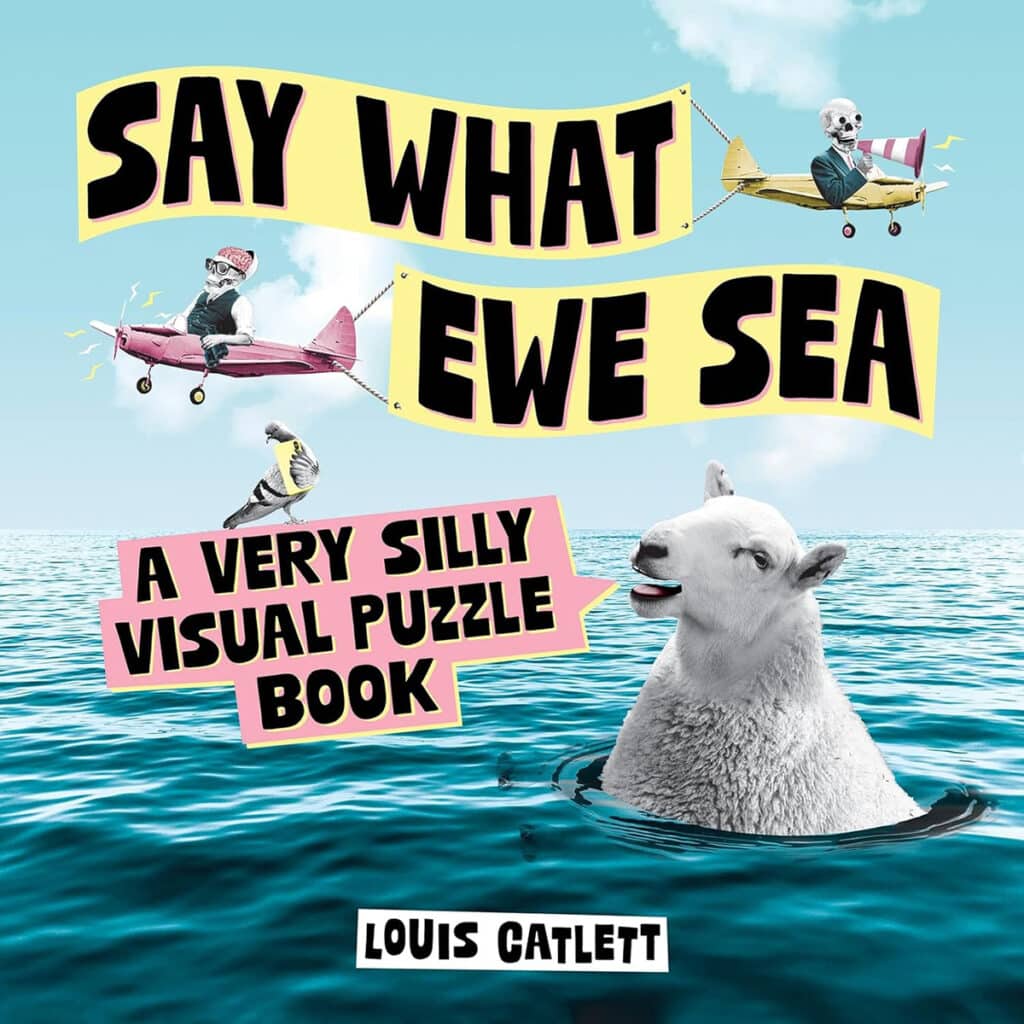
Publisher: Summersdale Publication date: 9th October 2025 Buy ‘Say What Ewe Sea’
This article contains an affiliate link. Purchases through this link may result in us earning a commission.

