

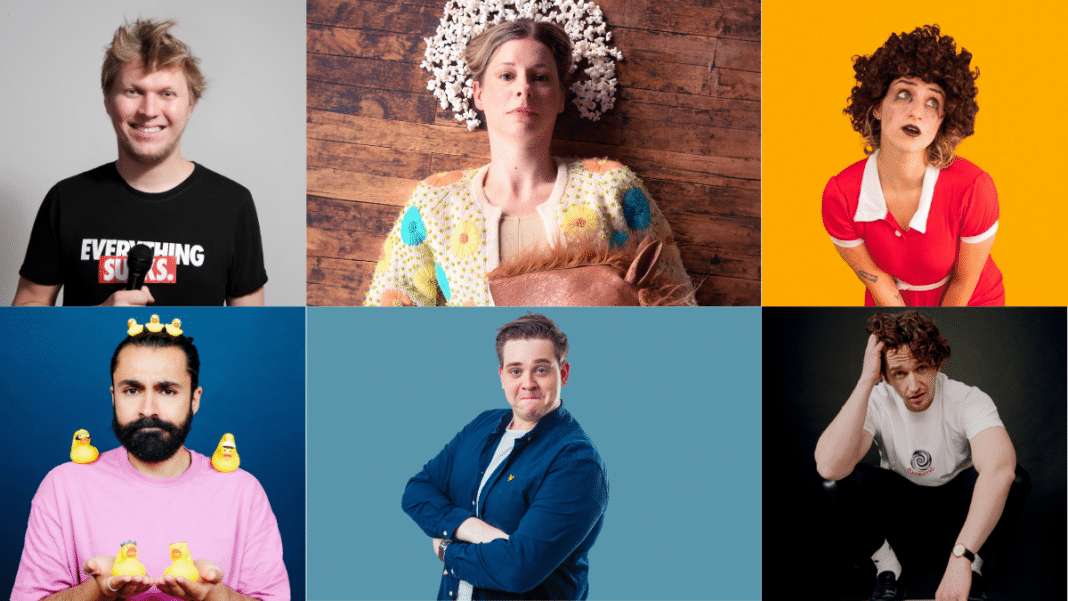

Year-after-year, despite rising costs to artists, the Edinburgh Festival Fringe attracts comics from all around the world clamoring to perform to Fringe crowds. Why? For globetrotting comics such as Dima Watermelon, Julia VanderVeen, Milo Edwards, Ollie Horn, Jamie Lerner and Mustafa Algiyadi, coming to Edinburgh is the only place on earth they can hone their craft to a discerning crowd.
Dima Watermelon
Dima Watermelon is a Ukrainian standup comedian who gigs predominantly in Berlin and other European cities including Prague, Brussels and Amsterdam. Dima is risking huge financial losses performing his debut standup hour in Edinburgh this month – to him, it is vital to perform to a Fringe audience in order to truly know if he's at the top of his game.
Dima says, “European audiences are quite new to standup and there is no standup culture yet compared to UK, so definitely British audiences are better. Partly because they are native speakers but also because they are familiar with standup and are savvy about what you are trying to do. For example, in Europe, you can get away with hacky jokes or some lame crowd work as people don't know any better.
“In Europe the bar is quite low and there is not much pressure to grow comedically, as you are killing already with mediocre jokes. To improve as a comedian you want to perform in the UK, and especially at the Fringe, as you get people who know standup and can appreciate your comedy.”
Julia VanderVeen
Julia VanderVeen is a New York based actor and physical comedian. She has a degree in Music Theatre from Illinois Wesleyan University. Julia has trained extensively in Clown and Bouffon, and apprenticed under head of physical theatre at Yale University, Christopher Bayes. Julia has worked all over the United States, and performed in places as remote as Alaska, and as tropical as the Mediterranean, and My Grandmother's Eyepatch is her debut in Edinburgh.
Julia says, “I think it is great to shake it up and try my work in other places. I have played all over the US, and some places in Canada and the reactions can be surprising. My show did really well in Orlando for example, which shocked me, but not as well in Winnipeg, which is maybe less surprising.
“Edinburgh brings comedy lovers from around the world and they want to laugh, but they’ve also seen a lot of comedy, so they know right off what is good and more sophisticated than just the run of the mill.
“I also think whatever comedy scene you’re in, it can get a bit incestuous in that your style and what you laugh at gets influenced by your friends and the fact that you know each other. When I take my work somewhere new, and especially somewhere as international as Edinburgh Fringe, I am given a really great idea of how it stacks up and it inspires me to work even harder.
“My medium is clown/physical comedy and the tradition of clowning in Europe is much longer and more respected than it is in the US. The clown work that is coming out of both the UK and Europe at large is very exciting to me. So much so that my partner and I are considering moving to Amsterdam, and I am very much hoping to collaborate with the clowns there as well as in London.”
Milo Edwards
Milo Edwards has had one of the most intriguing careers in comedy – going from student comedy to Russian TV stand-up, to becoming one of the UK’s most successful indie podcasters (with Trashfuture) and having three hit solo shows at the Fringe.
“I’ve toured extensively around the UK, Europe, Russia and Australia and European audiences, on the whole, aren’t as literate in comedy because stand-up isn’t as developed in those markets – with the possible exception of the Netherlands because they watch so much English TV – and so their tastes, at least in English comedy, tend to be a bit simplistic.
“The fairly dry nature of British culture, I think, produces good comedians in that it forces them to write jokes rather than get by on delivery or personality. The somewhat brutal nature of UK weekend clubs also forges hardened performers and, despite not really being a club stalwart myself, I do find myself missing it when I’m touring abroad – I did a few nights at the Sydney Comedy Store a while back and a couple of the nights were totally devoid of any sort of energy or atmosphere and then one night we had a Glaswegian stag-do in and it was such a relief, I felt like I was on home turf.”
Ollie Horn
Ollie Horn has honed his craft across 25 countries, including becoming a TV presenter in Japan and gigging at military bases in South Korea, the flagship Apple Store in San Francisco, hostels in Barcelona and a 20-seater river cruise on the Sunshine Coast of Australia.
“I found that early on in my career, going to European clubs was a great way to get lots of low-risk stage time, for quite a lot of reward. In the UK, there are considerably more performers than opportunities. In these nascent comedy scenes, the supply can't keep up with the demand.
“There are lots and lots of young, internationally-minded people, whose friendship group's lingua franca is English, for whom going to a comedy night is a no-brainer social activity. For them the product isn't the quality of the performance, but the experience.
“Performing in Europe can feel a little wild west. People who wouldn't be able to make a dent in an established market such as London or New York are able to grow very quickly and build an audience for their clubs with seemingly less friction. It also means that acts who wouldn't get past open spot level in the UK are ‘headlining' clubs, because there literally isn't anybody else to do the job.”
The Fringe attracts an audience of people who know comedy – and the arts in general – very well, and it shows in the quality of performance they expect. I’ll see MCs in comedy clubs in nascent markets in Europe and South East Asia ask the question “who’s not seen live comedy before?” and it’s remarkable how often it’s the majority of the audience.”
Jamie Lerner
After graduating from NYU in 2015, Jamie moved to Barcelona to teach English and started doing stand-up and musical comedy. She brought a split hour to the Brighton and Edinburgh Fringes in 2023, winning a Best of Brighton Fringe award, and is now bringing her first solo show, F*ck Tomorrow, to Southsider in 2024.
“As an American, the Edinburgh Fringe didn't hold much water to me until I saw Phoebe Bridgers' Fleabag. All of a sudden, I realized there was a path to creating a show that wasn't just rising up in the New York City comedy clubs with 15-minute club sets.
“Many of the comedians and artists who have moved away from their homes are often seeking some greater meaning while attempting to hold onto the inspiration and youth that brings us joy. In Barcelona, where I live, there is an abundant scene of comedians from all over the world performing in English alongside some of the greats, like Michelle Wolf, who's based here. And the one thing we have in common is that we all left our homes to pursue comedy … in English … in Barcelona. Comedians are curious people, always eager to learn and discover new things, so it makes sense that we would have that in common. But a scene with frequent visiting comedians and a small but dedicated group of locals can only go so far, which is why many of us make an annual pilgrimage to the Edinburgh Fringe.
“There's almost 4000 different shows to see in every genre, people to meet from around the world, and opportunities to perform like no other. It allows us to envision a career path in performance in which we can better ourselves in Edinburgh by performing more than ever and create a path to touring throughout Europe, and perhaps the UK if audiences vibe with our material. And because we have a different perspective — we weren't raised on the Edinburgh Fringe as a be-all end-all like many UK-based artists — we offer our own new and different styles of comedy. As the biggest arts festival in the world with a couple million attendees, we're bound to find our people.”
Mustafa Algiyadi
German-based Libyan stand-up, Mustafa Algiyadi's debut show explores how moving to Europe messed with his concept of belonging and identity. He has opened for Reggie Watts and Todd Barry at his weekly comedy night in Munich (the city's first weekly English comedy night) and has toured across Europe. He performs in Arabic, Italian and German.
“Performing in the UK is a completely different game to performing standup in English in Europe. The market is more saturated, the audiences are more sophisticated due to the exposure. For example, it is way more difficult to get laughs for cliche jokes in the UK. I remember once doing a “Germans are not funny” gag in the UK, and I got rolling eyes from an audience member. Such a joke works with the expats in Germany.
“I prefer the UK comedy scene for its diverse and not-monochromatic audiences. In the UK, audiences come from various societal layers, creating a dynamic environment for crowd work and interactions during the performance. In Europe, English-language comedy audiences are usually the expats who are working in similar fields like tech or academia, biasing the type of jokes that land as they cater to a specific group and makes crowd work more predictable and repetitive. British audiences tend to heckle more, which is a friction that is very important for the development of a standup comic.”

