

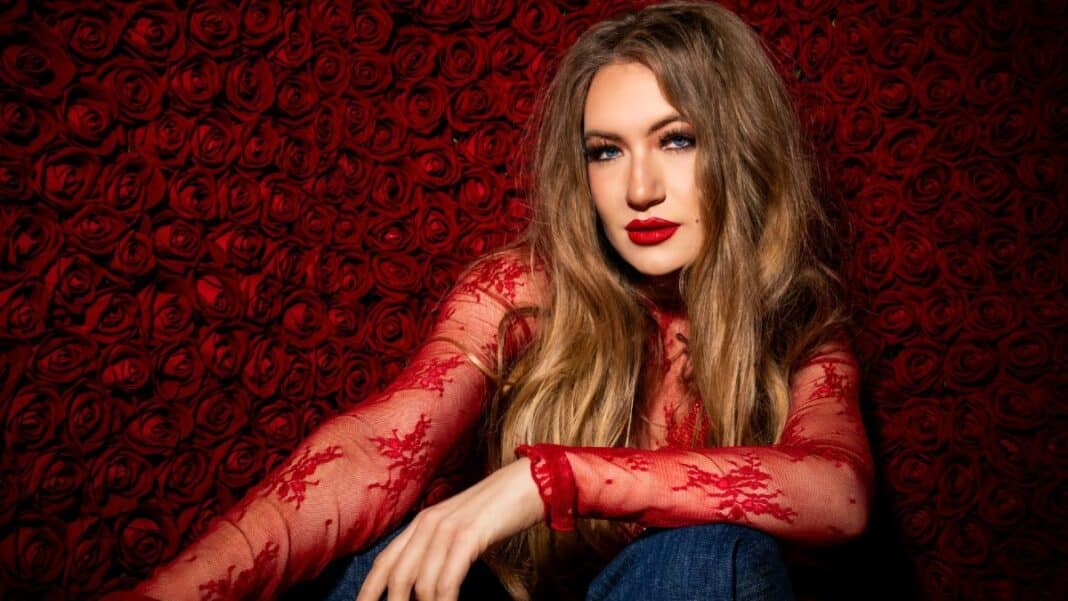

Kentucky-born and Nashville-based, Mary Kutter spent years building a reputation as one of Music City's most intriguing behind-the-scenes writers before stepping into the spotlight herself. Raised in the heart of bourbon country, Kutter developed a songwriting style steeped in vivid storytelling, dark humour and the Southern Gothic imagery that would later become her artistic calling card. Her sharp pen earned cuts with rising stars including Bailey Zimmerman, Nate Smith and Zach John King, while her work on Smith's platinum-certified ‘Wreckage' helped establish her as one of Nashville's most promising writers. At the same time, she began cultivating a substantial social media following through raw, unfiltered performances of her original songs, attracting more than a million followers across platforms and building a fiercely loyal audience long before signing a record deal.
That momentum culminated in early 2026 when Kutter signed with BBR Music Group/BMG Nashville and launched her recording career with debut single ‘Bed of Roses.' Refusing to soften the rough edges that had made her stand out, Kutter brought a distinctive blend of country storytelling, rock-and-roll attitude and cinematic flair to the release. Inspired in part by the storytelling traditions she grew up loving and fuelled by her determination to prove doubters wrong, ‘Bed of Roses' introduced listeners to an artist unafraid to embrace dark humour, flawed characters and unconventional narratives. We caught up with her in Nashville during CMA Fest week to talk all about it.
It's lovely to talk to you Mary, thanks for your time. I have to say, your Instagram feed terrifies me… but it’s also one of my top five must-watch feeds right now. It completely stands out. Is that all your own creation?
Well, first of all, I’ll take that, sugar, that’s a heck of a compliment. But yeah, it really did come together pretty organically. When I first moved to Nashville, I was writing songs for other artists, folks like Bailey Zimmerman and Nate Smith. And I watched their careers change in real time because of social media. Seeing that happen from the outside, I realised how powerful that tool could be. So I thought, if I ever got the chance to start putting music out for myself, I’d just commit to it and keep showing up. And that’s exactly what I did. I started writing every day, filming whatever we created that day on my phone, and posting it: no overthinking, no worrying about lighting or angles or any of that.
And I think that rawness is what people connected with. It wasn’t polished, it wasn’t perfect, it was just real. And over time, it kind of developed into its own thing, visually and creatively. That whole Southern Gothic, theatrical feel, that comes from where I’m from. I grew up in the sticks of Kentucky, and there’s a certain grit, a certain darkness, a certain beauty to that place. It’s not something I sat down and tried to manufacture: it’s just part of who I am, and it naturally comes through in what I do.
Does social media dominate your thoughts now, or are you able to switch off from it?
You know, early on when I started posting, I kind of made a decision with myself that I didn’t want social media to take over my life in that way. So I got into the habit of posting something and then putting my phone down: not sitting there refreshing it, not obsessing over numbers, not letting it dictate how I felt about what I was doing. Because I think it’s really easy to get caught up in that, and once you do, it can kind of mess with your head and your creativity.
If I’m being honest, what actually occupies my thoughts way more than social media ever could is songwriting. I’m constantly thinking about ideas, little phrases, storylines, characters, images. It’s like there’s always something turning over in my head. I write every day, but there are certain songs that I’ll keep coming back to, tinkering with over time, and that’s usually how I know there’s something special there.
So yeah, social media is a tool, and it’s been an important part of what I’ve built so far, but it’s not the thing that drives me or keeps me up at night. What keeps me up is chasing the next song and trying to figure out how to tell a story in a way that feels honest and different. That’s where my energy really goes.
Before we get to your own music, is there one song you’ve written for another artist that you’re most proud of?
That’s a great question, because it’s hard to pick just one, every song kind of carries its own story and its own chapter of your life with it. But if I had to point to one that really stands out, both personally and professionally, it would be ‘Wreckage,' the song that Nate Smith recorded.
That one means a lot to me for a bunch of reasons. From a career standpoint, it was a big milestone, it went platinum, it was my first Top 20, and it really helped open some doors. But beyond that, it’s the way that song came together that makes it special. We wrote it right before Christmas, and Nashville was basically a ghost town. Everybody had gone home for the holidays, and the three of us who wrote it didn’t have anything going on at the time: no deals, no big plans, nothing lined up.
We were just in a buddy’s spare bedroom, crammed in there, writing because that’s what we love to do. And the song came from a really honest place, just talking about unconditional love and what it looks like to stand by somebody even when things aren’t perfect. There wasn’t any pressure on it, no expectation that it was going to be anything other than just another song.
So to watch it go from that moment , three people with “a whole lot of nothing,” just trying to write something real, to becoming a platinum record that connected with so many people… that’s pretty wild. It’s one of those songs that reminds you why you do this in the first place.
One of the things that really stands out about you as an artist is how naturally you lean into a more rock-driven sound. There’s a real energy there that feels just as influenced by classic rock as it does by country storytelling. Given your background as a songwriter in Nashville, how intentional has that been for you, and do you see yourself as sitting between those two worlds rather than fully in one or the other?
Yeah, I think that’s a really fair way to describe it. I’ve never felt like I fit neatly into just one lane, and I’ve never really wanted to. The songwriting side of me is very rooted in country, because that’s what Nashville teaches you. It’s about telling a story, building characters, making people feel something real. That foundation is always going to be there in what I do.
But sonically, and especially when it comes to the live show, I’ve always been drawn to something with a little more grit and energy. I want it to feel big, a little dangerous, a little theatrical. I want people to feel like they’re part of something, not just watching someone stand there and sing. So bringing in those rock elements, the guitars, the dynamics, the attitude, that’s been a very intentional choice.
I think the cool thing is, those two worlds aren’t as far apart as people sometimes think. A lot of the country music I grew up loving had that same kind of edge to it, even if it wasn’t labelled as rock. It’s all about emotion and delivery. So for me, it’s not about choosing one or the other, it’s about finding a way to blend them in a way that feels authentic.
And live, that’s where it really comes to life. That’s where I can take the songs I’ve written, whether they’re for me or for other artists, and kind of reimagine them in this bigger, more cinematic way. We’ve been doing these medleys where we stitch songs together, add heavier instrumentation, and just build these moments that feel almost like scenes in a movie. At the end of the day, I just want it to feel honest. I don’t want to water anything down to fit a box. If it leans rock, it leans rock. If it leans country, it leans country. As long as it feels like me, that’s what matters.
Let’s talk about your record deal. When did you first realise labels were interested, and why did you choose Broken Bow?
Yeah, it was a pretty wild process, honestly. Everything really kicked off after ‘Devil’s Money' started picking up traction online, that was early in 2024, and all of a sudden I had labels reaching out, wanting to meet, wanting to talk about what I was doing. It all happened pretty quickly, and before I knew it, I was sitting in rooms with people I’d only ever heard about before.
I ended up having three different offers on the table, and every single place I met with had great people, there wasn’t a bad experience in that sense. But when I walked into BBR Music Group/BMG Nashville, something just felt different right away. And I know that sounds like one of those things people say, but it really was a gut feeling. The energy in the room, the way they talked about the music, the way they listened. It just clicked for me.
The biggest thing, though, was that they weren’t trying to change me. They weren’t looking to smooth out the edges or make what I do more palatable or more “radio-friendly” in a traditional sense. They understood that what I’m doing is a little different, especially as a female artist in country right now, and instead of being scared of that, they leaned into it. They saw what people were already connecting with and wanted to build on that, not dilute it.
And I can’t say that was the case everywhere. There were definitely conversations where it felt like the instinct was to tone things down, to make it fit more comfortably into a box. And that just wasn’t something I was willing to do. I’d rather be a little polarising and make something that feels true than try to be everything to everyone. So choosing Broken Bow really came down to that trust. It felt like a place where I could grow as an artist without losing what makes me, me. And that’s all you can really ask for when you’re stepping into a partnership like that.
You’ve described yourself as a bit like Tabasco — you either love it or you don’t. Is that how you see your artistry?
Yeah, I think that’s honestly the best way I can describe it. I’m kind of like Tabasco sauce. You either really like it, or you really don’t. And I’m okay with that. I don’t think what I do is meant to sit comfortably in the middle or appeal to everybody, and I’ve made peace with that.
To me, the goal isn’t to be the safest or most universally liked version of something, it’s to be something that actually makes people feel something. If that means some people don’t connect with it, that’s fine, because the people who do connect with it are really going to connect with it. I’d much rather have that than something that just kind of washes over everyone and doesn’t leave much of an impression.
I always think about it like this. There’s a place for vanilla, and vanilla’s great. You need it for certain things, it’s a solid foundation. But I’m not trying to be the vanilla. I’m more interested in all the other flavours that you layer on top, the stuff that makes it a little more unexpected, a little more memorable. You know, I always think about it like a Fluffernutter Blizzard, that’s my favourite thing in the whole world. You’ve got to start with vanilla ice cream, right? You need that as the base. It holds everything together. But then you add in the good stuff, the Reese’s cups, the warm marshmallow cream, and that’s what makes it what it is. That’s the part people remember. That’s where the flavour really comes from.
So yeah, vanilla’s important, don’t get me wrong. But I’m not trying to be the vanilla. I’m trying to be everything you pile on top that makes it a little wild, a little different, and a lot more interesting. That’s how I approach my music and my whole artistic identity. It’s going to be a little bit different, a little bit edgy at times, maybe a little uncomfortable for some people. But it’s honest, and it’s me. And if that makes it a bit polarising, then so be it. I’d rather be that than watered down.
‘Bed of Roses' is your first release with Broken Bow. Why was that the right song to introduce this new chapter?
That’s a really good question, because there were a lot of songs we could’ve led with, and I’ve got quite a few that I love and feel strongly about. But ‘Bed of Roses' just felt like the right introduction to this chapter for a few different reasons.
First off, it still sits right in the lane of what I do best, which is storytelling. A lot of the songs that have brought people into my world so far are very narrative-driven, they’ve got characters, they’ve got a beginning, middle and end, and ‘Bed of Roses' definitely fits into that. But at the same time, it pushes things a little further stylistically. The spoken verses, for example, that was a really fun creative choice. Instead of singing everything, it’s like, “No, we’re gonna talk this part, almost like you’re letting someone in on a secret.” And that adds to the theatrical, cinematic feel of it.
What really sealed it for me, though, was seeing how it connected live before anyone had even heard it. I hadn’t posted any of it on social media, once I knew we were going to record it, I wanted to hold it back until it was ready. So the first time anyone heard it was at a show where I was opening for Randy Houser. Nobody in that room knew the song. There’s that little part in the chorus — the “ah, ah, ah, ah, ah” — very AC/DC-inspired, I’ll admit, and by the end of the song, the crowd was already singing it back to me. That was one of those moments where you go, “Okay… there’s something here.” I’m the opener, they didn’t come to see me, and they’re already locked in.
So it just felt like the perfect way to introduce myself on a bigger stage. It’s got the storytelling, it’s got the edge, it’s got that slightly off-kilter, almost Alfred Hitchcock-meets-country kind of vibe. It represents what I do, but it also hints at where I can go. And that felt like the right place to start.
One of the things that really strikes me about your songwriting is just how visual it is. Songs like ‘Bad Apple,' ‘Sloppy Joe' and now ‘Bed of Roses' don’t just tell a story, they feel like scenes from a film, almost like you’re watching everything unfold in real time. When you’re writing, are you consciously thinking in those cinematic terms?
Oh, they absolutely come to me that way. It’s almost like I can’t separate the two. When I’m writing, I’m not just thinking about lyrics or melodies, I’m seeing the whole thing play out in my head like a little movie. There are characters, there’s a setting, there’s a mood, it’s all there from the jump.
And what’s wild is how those ideas can start from the smallest, most random things. Like ‘Sloppy Joe,' that came from me just being out on a walk one day. There’s a White Castle not far from here, and they had a sign up that said, “Sloppy Joes are back.” And I remember stopping and thinking, “Man, that’s a great title… but what would that song even be about?” So then my brain starts going, “Okay, ‘Sloppy Joe’… that’s gotta be a guy who’s sloppy, right? What does that look like? Maybe he’s a cheater, maybe he’s not covering his tracks, maybe everything’s kind of falling apart around him.” And from there, it just builds into this whole world and this whole story.
That’s how it usually works for me. I’ll get a spark like that, and then I just follow it. I start seeing the scenes, how it opens, where it goes, how it ends. And I think that’s why the songs feel so visual, because I’m not just writing them, I’m kind of watching them happen as I go.
It’s one of my favourite parts of songwriting, honestly. Those ideas are everywhere, you just have to be paying attention. And once you catch one, it’s like, “Alright, let’s see where this story wants to go.”
‘Wedding Night' feels very personal. That's another one of my favourite songs of yours. Is that based on a real story?
Yeah, that one is actually a true story, which is probably why it hits the way it does. I dated this guy, and after we broke up, he got married less than five months later! And when that happened, it was just… it was a lot to process. It felt like a bit of a whiplash situation, you know? One minute you’re in something with someone, and the next, they’ve completely moved on and are starting a whole new life.
What’s interesting is I hadn’t written about that experience for a long time. A lot of my songs are more character-driven or story-based, and they don’t necessarily come directly from my own love life. I actually tend to gravitate toward those kinds of songs more often. But one day, I was out on a run, and for whatever reason, my mind just went back to that situation. I started thinking about him, about what had happened, and how quickly everything had changed. I remember thinking, “Man, that really was kind of a wild experience.” Especially the moment I found out he was getting married, it all just felt so sudden. That’s when the idea for ‘Wedding Night' started to take shape.
When we wrote it, we made a really conscious decision not to make it bitter or angry. It would’ve been easy to go there, but that’s not what I wanted. Instead, we leaned into something a little more haunting and reflective, almost like it could be played at a wedding, but with this underlying twist of, “Yeah… this isn’t your story anymore.”
Writing it was definitely cathartic. It gave me a way to process something that I hadn’t really put into words before. And I think that honesty, without the anger, is what makes the song resonate the way it does.
Given how bold and unconventional some of your ideas are, have you ever been in a writing room where you’ve brought something to the table that felt maybe a little too left-field and the other writers have just flat-out said, “No, we’re not doing that”?
Oh, absolutely. That has definitely happened! (laughing) The one that always comes to mind is a song idea I had called ‘The Devil Wore a Lab Coat.' I carried that idea around for months, and every time I went into a writing room, I’d pitch it. I’d explain what it was about, where it was coming from, and more often than not, people would kind of look at me and go, “A song about big pharma? What else you got?”
And I understood that reaction. It’s not an obvious country song topic, and it’s not exactly the easiest thing to wrap into a three-minute format. But it was something that was really on my heart. Growing up in Kentucky, you see firsthand how the opioid crisis has affected communities. It’s not abstract: it’s real people, real families, real consequences. I was actually up in Harlan, Kentucky recently, which is in the eastern part of the state where a lot of the coal mining communities are. It’s one of the areas that’s been hit the hardest. It’s a beautiful place, the mountains are incredible, the people are wonderful, but there’s also a level of poverty and struggle there that’s hard to fully grasp until you see it up close.
I played a rehab centre while I was there, and that experience really stuck with me. It kind of reignited why I wanted to write that song in the first place. Because even though it might not be the most conventional topic, it’s something people are still living through. People are still trying to recover, still trying to rebuild their lives. So yeah, it took a while to find the right room and the right moment to write that song, but I never let it go. And that’s kind of how I am: if something feels important, I’m going to keep coming back to it, even if it makes people a little uncomfortable at first.
At the end of the day, if a song like that can make even one person feel seen, or feel a little less alone in what they’re going through, then it’s worth pushing through those initial “no’s” to get it written.
Looking ahead, if we’re sitting here again in a year’s time at CMA Fest 2027, what do you hope has happened for you?
Oh man, I love that question! (laughing) It feels like we’re getting to manifest a little bit here, which I’m all about. If we’re sitting here this time next year, I’d love to be talking about my first full album being out in the world. That’s a big one for me. I’ve spent so much time writing, figuring out who I am as an artist, building all of this from the ground up. So to have a full body of work out there that really represents me, that would be huge.
I’d also love to have a song at radio. That’s something I’ve worked toward for a long time, and it would be really special to see one of my songs connect in that way on a bigger scale. Not just online or at shows, but out there where people are hearing it in their cars, on their daily drives, becoming part of their lives in that way.
And then honestly, I’d love to be playing more shows, especially internationally. The idea of taking what I do, the music, the energy, the whole theatrical thing, and bringing that to audiences outside the States, places like the UK and Europe, that’s really exciting to me. I feel like it would connect in a different way over there, and I’d love to experience that.
More than anything, though, I just want to keep building. Keep growing, keep reaching more people, keep telling stories that matter. If we’re sitting here a year from now and I can look back and say I stayed true to what I do and pushed it forward, then I’ll feel pretty good about it.

